
YouGov: Who are gamblers’ favourite football teams?
Charlie Dundas analyses data from YouGov FootballIndex and details how marketers can use it to their advantage
With the football season up and running, we thought we would have a look at some of the data captured by our new product – YouGov FootballIndex – to see what light it can cast upon the favourite teams of gamblers and what that might mean for marketers. YouGov FootballIndex records Britons’ views on every Premier League team – as well as many top European teams. It tracks every team against 16 metrics – so we know whether clubs are perceived as having good coaches, a strong tradition, whether they are being talked about, watched and much more. For this analysis, we thought we’d look at a couple of those metrics among a specific audience – regular gamblers – defined as those who have gambled (online or on the high street) at least once in the past month. Let’s start by looking at the clubs which gamblers consider to be the most likeable (‘Regardless of whether or not you are a fan of a certain football club, which of the following football clubs do you personally consider in principle to be likeable?’). In order, they are Liverpool, Man City, Leicester City, Manchester United, Spurs, Arsenal, Wolves, Brighton, Newcastle and Chelsea. The top 10 are separated by a 10-point spread. Almost one in five (19%) of gamblers find Liverpool likeable, five points more than their nearest rival in Manchester City. Beyond the top two, there’s only 4% difference between the rest of the top 10. So, what does this mean for marketers? Well, of the top 10 most likeable clubs, only two – Wolves and Newcastle – are sponsored by betting brands (ManBetX and W88), leaving a host of likeable clubs without shirt-front attachments in the sector. What else? Is likeability a proxy for the teams that gamblers are more likely to bet on? It’s not a question we’ve asked so we can’t say without industry data but, reader, you may be able to join those particular dots.
Fan favourite
Probably a closer proxy is favourite team (‘Which of the following football clubs is your favourite club?’). While it makes sense that gamblers, whether serious or casual, would bet on teams they know more and care more about, there’s also a case to be made that they may choose to bet on (or against) teams they dislike. Here the top 10 is different – see the chart below. The scores represent the percentage of all respondents who told us that this was their favourite team.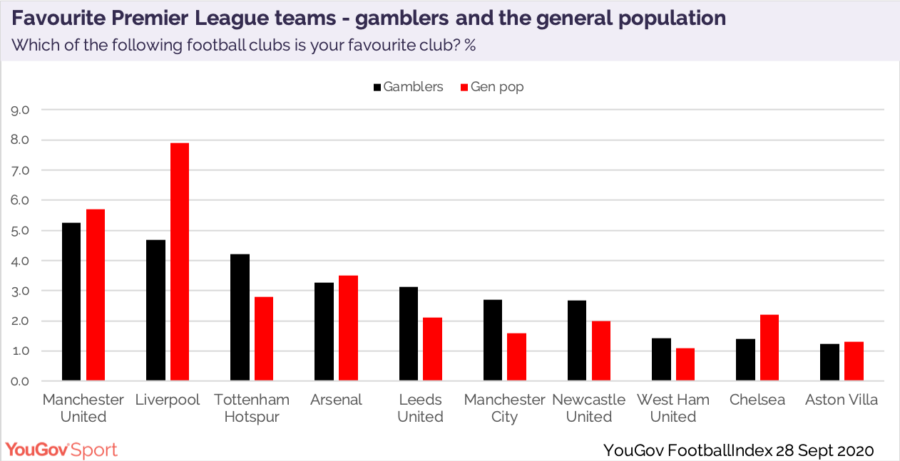 Of the new entries, Leeds (SBOTOP) and West Ham (Betway) have shirt sponsors which are betting companies.
The difference between these scores and those of the general public are worth remarking on. The top two are reversed, for example, with Liverpool easily beating Manchester United among the general population but Manchester United are the more popular of the two among gamblers. Both are significantly more popular among the general population than they are among gamblers. Manchester City’s fanbase among gamblers is much higher (2.7% as opposed to 1.6%), as is Spurs’ (4.2% compared to 2.8%).
On first inspection, we can’t detect a particular reason why gamblers are more likely to be fans of Spurs, Leeds, City and Newcastle but it just goes to show how useful it is for marketers to have this level of data. In terms of reach, it’s definitely worth understanding that marketing to fans of Leeds is as likely to reach gamblers as a campaign through a club like Arsenal, which will hit a similar number of gamblers but which is likely to come at a much greater financial cost.
Of the new entries, Leeds (SBOTOP) and West Ham (Betway) have shirt sponsors which are betting companies.
The difference between these scores and those of the general public are worth remarking on. The top two are reversed, for example, with Liverpool easily beating Manchester United among the general population but Manchester United are the more popular of the two among gamblers. Both are significantly more popular among the general population than they are among gamblers. Manchester City’s fanbase among gamblers is much higher (2.7% as opposed to 1.6%), as is Spurs’ (4.2% compared to 2.8%).
On first inspection, we can’t detect a particular reason why gamblers are more likely to be fans of Spurs, Leeds, City and Newcastle but it just goes to show how useful it is for marketers to have this level of data. In terms of reach, it’s definitely worth understanding that marketing to fans of Leeds is as likely to reach gamblers as a campaign through a club like Arsenal, which will hit a similar number of gamblers but which is likely to come at a much greater financial cost.
 Charlie Dundas is commercial director at YouGov Sport, the sports and entertainment division of global research and insight agency, YouGov. YouGov Sport tracks the public’s perceptions of sports events, leagues, teams and athletes every day in markets across the world on a daily basis.