
YouGov: should video game loot boxes be subject to regulation?
Data shows the public links video game loot boxes with gambling, but what do they want to do about it?


As many (but not all!) of us sit at home with less to do than usual, much of the population is turning its attention to alternative pursuits to keep busy. And since gardening and jigsaws have been around since the Spanish flu, some people are looking for a more modern pastime to fill their days. Enter video games.
For many, playing video games will be an extension of existing habits, and these people will simply be getting better at FIFA or Call of Duty. But for those who haven’t played in the past decade, the omnipresence of loot boxes may be both puzzling and surprising.
In fact, a recent study quoted in The Lancet estimates that over half of top-grossing mobile games now contain this component (for the uninitiated, boxes of uncertain game-related content, like equipment, skill or ammo, bought with real cash).
Meanwhile, academics at the University of York suggest that among the top desktop games, the prevalence of loot boxes has increased from about 4% to about 71% over the last nine years.
Whichever figure you believe (and both may be true), there’s no doubt that loot boxes now play an important role in video gaming – and also that many believe them to be at the root of some problem gambling.
The argument goes that young people (and The Lancet says that 94% of the mobile games in the study it quotes are approved for children over the age of 12) are unwittingly coaxed into soft gambling when they buy the boxes. And since the activity mimics slot machines or roulette, their purchase can act as a gateway to problematic behaviour. At the very least, some argue, the sale of loot boxes represents unregulated gambling – and that, they say, is a problem in itself.
So what do British people think of this situation? Well, we found out.
It’s worth noting out of the blocks (because we found it surprising) that the majority of Brits play video games at least occasionally – whether on their phone, on a console or a computer.
In fact, only 43% tell us they never play video games, with 32% playing ‘frequently’ or ‘fairly frequently’ (rising to 51% among 18-24 year olds). That gives us some reassurance about the rest of the responses, since gamers are likely to be better informed on the issue – or at least may have encountered loot boxes.
In fact, 17% of our sample told us that they had bought a box in the past. This figure rises to 25% among 18-24 year olds. More than three-quarters (77%) say they haven’t done so, nor do they intend to.
Across our sample, the majority of people (56%) believe that loot boxes are indeed a form of gambling. In fact, only 10% disagree, making it a pretty overwhelming result (the rest told us that they didn’t know).
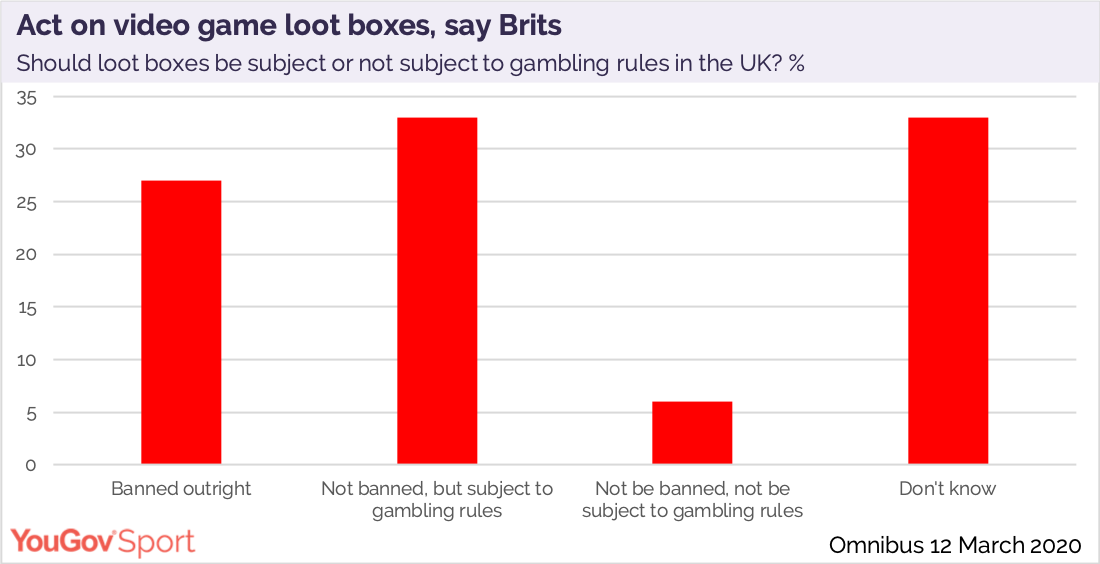
And again, a majority of people want to see action taken against this gaming feature.
More than a quarter (27%) believe loot boxes should be banned outright (falling to 14% among younger people), while a third (33%) believe a more measured response would be to make them subject to gambling rules. Interestingly, the proportion of people taking this latter view rises to 43% among younger people.
Only 6% took a completely laissez-faire attitude and believe that loot boxes should neither be banned nor subject to gambling rules (rising to 10% among younger people).
While loot boxes remain at the periphery of most gaming experiences, these figures definitely suggest the British public is in favour of a precautionary approach. If the alternative is banning loot boxes and having young people join the virtual queues for jigsaws and plants, you can perhaps see why…

Charlie Dundas is commercial director at YouGov Sport, the sports and entertainment division of global research and insight agency, YouGov. YouGov Sport tracks the public’s perceptions of sports events, leagues, teams and athletes every day in markets across the world on a daily basis.