
What will we do when football finally turns its back on the bookies?
Sam Behar, commercial director at Tomorrow TTH, calls on the industry to embrace impactful change ahead of the inevitable gambling advertising shake-up

On 14 May 1995, Nigel Mansell set off at the Spanish Grand Prix, where he retired from the race unhappy with the handling of his car. It would be his last race in Formula 1. Such an iconic driver deserved an iconic car and while the performance of his Mercedes engine was not up to scratch, you can’t fail to remember the famous Marlboro McLaren. When looking at that car today you get the sense that you are looking at a piece of art. You don’t see the fact that the title sponsor is a cigarette brand, you simply notice the famous red and white. It’s a painting.
There’s a reason for this. It seems so backwards and so antiquated that a brand selling cigarettes could appear as a front-facing piece of advertising in sport. Imagine today watching your side in the Premier League standing shoulder to shoulder with their teammates before kick-off with a big white Marlboro badge across their chest. Fast forward 20 years and, as a Newcastle fan, I’ll look back on Steve Bruce’s side with both frustration (naturally) as well as surprise that an Asian bookmaker was allowed to advertise on the front of the famous black and white shirt. It’s not strange right now, but trust me, it will be. We won’t remember advertising from Burnley, West Ham, Southampton or Palace in the same way we remember the Marlboro McLaren, we’ll just recall it as time gone by.
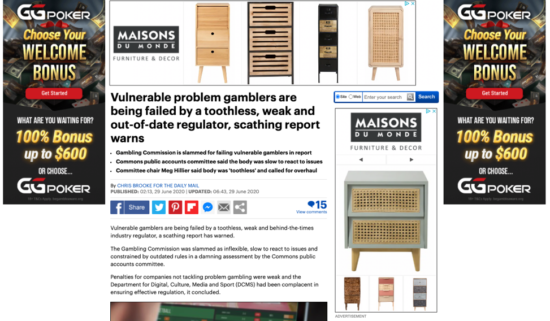
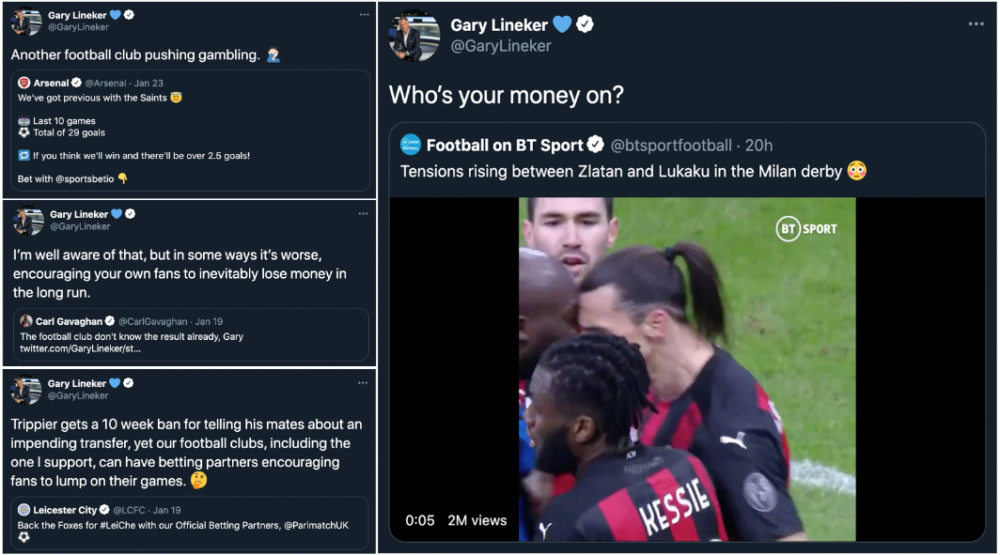
Everyone’s nervous about the gambling review currently taking place, and rightly so. The media have taken particular interest in this story and in attacking bookmakers in general over the last few years. The hypocrisy is often mind blowing with articles in the Daily Mail about problem gambling appearing alongside display advertising promoting 100% deposit match bonuses. Gary Lineker has been vocal on social media regarding clubs pushing messages to their fans about pre-match prices from their betting partners. He tweeted on 23 January saying “another football club pushing gambling” in response to Arsenal’s post from Sportsbet.io. He bemoaned Trippier getting a 10-week ban for “telling his mates about an impending transfer, yet our football clubs, including the one I support, can have betting partners encouraging fans to lump on their games”. He then finally retweeted BT Sport’s post about rising tensions between Zlatan and Lukaku in the Milan derby. He said: “Who’s your money on?” Slightly hypocritical, eh Gary? And presumably, you’ll not renew your contract with BT unless they stop accepting gambling advertising?
 That being said, is it right that children and vulnerable adults are exposed in the way they currently are to gambling brands through sport? More has to be done and I think all of us in the industry understand that shirt sponsorships will soon be a thing of the past. We get that perimeter boards may soon have time gating on their delivery. We appreciate that pushing posts from clubs’ social accounts won’t last forever and even more concerning we know that it’s unlikely operators will be able to use club IP in their advertising in the future.
 There is no doubt that restrictions are coming and, if we follow La Liga’s footprint, this will be far wider than simply not allowing bookmakers on shirts. The real question is, what will bookmakers do when sport finally shuts its doors on them? Operators have long continued to innovate and pivot their model, and they’ll have to do much the same this year and in to next. In the same way that Kingfisher sold water, Heineken sold alcohol-free lager and tobacco brands promoted vaping, bookmakers will have to think just as wide and just as creatively when devising their surrogate products. We have to consider what an advertising landscape will look like without any access to any sport and work backwards from there. Here’s what we should do.
Bookmakers need to become content providers. Pricing a market is part of the everyday narrative of this country. When Donald Trump took on Joe Biden in the US Presidential Election last November, oddschecker were called upon to provide rolling commentary on price shifts. I watched Dan Walker and Naga Munchetty on the curved red BBC Breakfast couch talk about “who they’d bet on”. When you listen to Alan Brazil in the morning on talkSPORT, you wait for Simon Clare to provide Coral’s take on the day’s events plus the outrights for the top and bottom of the table. These prices offer an insight into the likelihood of an outcome taking place. Bookmakers exist on this basis, they weigh up the options, they weigh up the form, they assess where the money is currently placed and they make a call on what they think will happen. This is rich, exciting and varied content that wide reaching audiences will engage with. It’s up to them to make a call on whether they back a market and, frankly, who they back it with, but imagine if bookmaker’s shifted their model and became content businesses.
There is no doubt that restrictions are coming and, if we follow La Liga’s footprint, this will be far wider than simply not allowing bookmakers on shirts. The real question is, what will bookmakers do when sport finally shuts its doors on them? Operators have long continued to innovate and pivot their model, and they’ll have to do much the same this year and in to next. In the same way that Kingfisher sold water, Heineken sold alcohol-free lager and tobacco brands promoted vaping, bookmakers will have to think just as wide and just as creatively when devising their surrogate products. We have to consider what an advertising landscape will look like without any access to any sport and work backwards from there. Here’s what we should do.
Bookmakers need to become content providers. Pricing a market is part of the everyday narrative of this country. When Donald Trump took on Joe Biden in the US Presidential Election last November, oddschecker were called upon to provide rolling commentary on price shifts. I watched Dan Walker and Naga Munchetty on the curved red BBC Breakfast couch talk about “who they’d bet on”. When you listen to Alan Brazil in the morning on talkSPORT, you wait for Simon Clare to provide Coral’s take on the day’s events plus the outrights for the top and bottom of the table. These prices offer an insight into the likelihood of an outcome taking place. Bookmakers exist on this basis, they weigh up the options, they weigh up the form, they assess where the money is currently placed and they make a call on what they think will happen. This is rich, exciting and varied content that wide reaching audiences will engage with. It’s up to them to make a call on whether they back a market and, frankly, who they back it with, but imagine if bookmaker’s shifted their model and became content businesses.
Duty of care
In the background, we all need to sign up to the protection requirements that the review will put in place, most notably protecting minors from seeing advertising from bookmakers and limiting the visibility of promotional material to vulnerable individuals. We also need to ensure that changes in online behaviour from customer’s normal patterns can be a sign of concern, and we need to help them. But we all need to assess that this is the moment to move and this is the moment to build better acquisition propositions. It’s easy, as I have done in this article, to wave the ‘why me’ flag but trust me operators are just the current cab off the rank to get the spotlight pointed at them. Once the review has taken place, there is no doubt in my mind that attention will turn elsewhere; namely financial services, trading platforms (GameStop ringing any bell?) and crypto currencies. From experience, I know how hard it is to sit in a board meeting and try to convince your peers to turn the oil tanker but turn it we must. As marketeers, problem solvers and bookmakers, we must do more, we must try harder and we must take this huge opportunity ahead of us to make a real long-lasting difference. This season’s shirt isn’t going to replace the iconic Newcastle Brown Ale one on my wall from ‘96 quite yet but who knows, maybe I’m wrong. Maybe one day I’ll look back on the 20/21 kit as a piece of art. Maybe the shirts from Burnley, West Ham, Southampton and Palace will spark a reference point. Perhaps the last few years in the Premier League will stir some fondness that while half the clubs have bookmakers on the front of their shirts, it represented a time when the industry got together, figured out how to do better and made real progress. So, let’s not step into smoking’s shoes, let’s innovate and let’s become synonymous with impactful change. And crucially, let’s hope Steve Bruce can steer Newcastle to safety by the summer. Sam Behar is the commercial director of advertising agency Tomorrow TTH. Specialising in media and creative, Tomorrow TTH helps businesses across a range of sectors to grow with particular expertise in gambling. Beforehand, Behar was head of marketing at Marathonbet, having sold his previous media business, Crave & Lamb.