
How to pivot and make the most of your marketing budget
Blueclaw Media's Sam Raife details how brands can pivot to new markets successfully even in uncertain times


A few people have covered the impact Covid-19 is having on marketing budgets, traffic and the markets to date, so let’s start by assuming we’ve all seen a sizable impact on marketing strategies in the last month.
As marketers, our job during these unprecedented times has been to support businesses and look for creative, alternative solutions in the form of medium-term strategies that will help pivot their brand into a new market.
Hopefully, our learnings from the last few weeks will support others to achieve additional revenue and stay afloat in an unexpected struggling economy.
Not everyone can pivot
There are a few rules to be able to pivot to a new market successfully, you need:
- An authoritative web presence
- The technical ability or willingness to learn
- The infrastructure to support a pivot
- Short-term capital.
So, to successfully pivot, at pace, into a new market you need to be in a position to have the capital to invest, a web presence that is already strong in another market, and the infrastructure to support the change in product line or service.
Unfortunately, you can’t suddenly be an expert in a new field and deliver a better service than your competitors. Or, at least it is very unlikely.
Where to pivot in the gambling sector
Let’s start with where not to pivot. Now is not the time to start your first egaming website, as we said before, it will take a site with significant authority and presence in another market to successfully shift focus in one of the most competitive online industries.
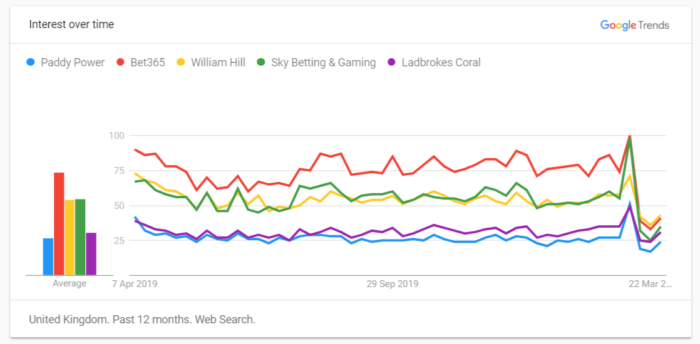
Google Trends has been a fantastic source of relevant information over the last few weeks. Here are a few patterns we’ve used to our advantage:
Source: Blueclaw Media
Traditional sportsbook is struggling and regardless of their brand dominance in almost every area, even these sites are finding it difficult to pivot their customers onto non-sports related gaming activities.
With that said, there are opportunities, but with the Gambling Commission (rightly) in overdrive to stop advertising to vulnerable ‘stay at home’ markets, they need to be approached compassionately.
The blocking of affiliates in the Virtual Grand National showed the efforts being made to keep the industry out of controversy as customers naturally look for alternative forms of entertainment, despite economic hardship.
Source: Blueclaw Media
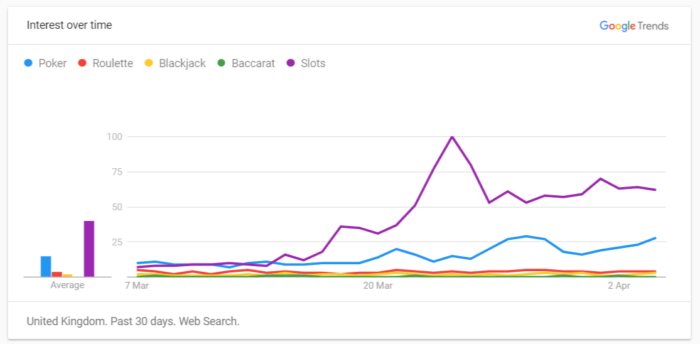
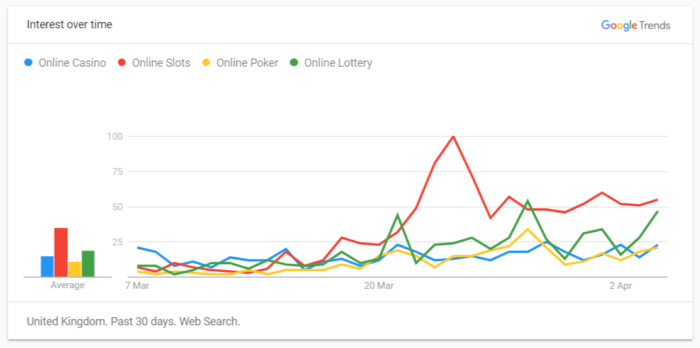
The information naturally screams to target Slots. However, a quick Google shows that this increase is purely related to ‘Online Delivery Slots’ for shopping, which piqued interest as a result of a news cycle on 24th March showing supermarket websites crashing.
Despite this, there has been a significant uplift and increase in traffic volumes around online slot games in the UK. ‘Online slots’ and revenue-driving key phrases in this SERP are holding strong. In fact, there has been a general increase of 106% compared to the days leading up the peak.
Source: Blueclaw Media
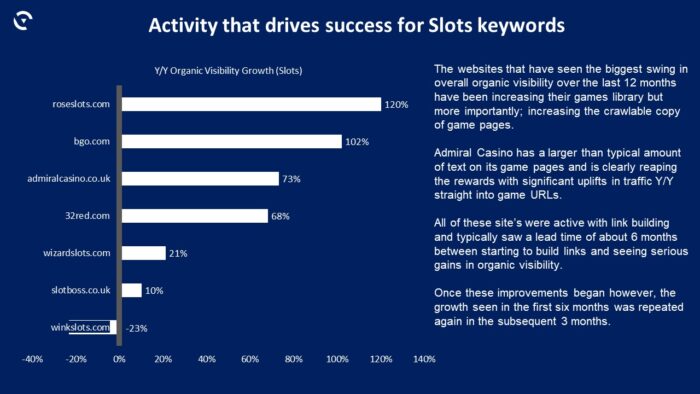
Our recommendations, however, haven’t revolved around ‘Online slots’. This is because of a report we put together highlighting that the biggest movements in the Online slots SERP resulted as a result of a complete overhaul of onsite content.
Source: Blueclaw Media
This as a strategy could be considered in the short or medium term, dependent on the resource available to deliver expert commentary, reviews and imagery around specific slot games.
Dealing yourself a better hand
With so many variations, a strong online community and a sport-like interaction and approach, Poker is the rising star that will likely outlast the current crisis.
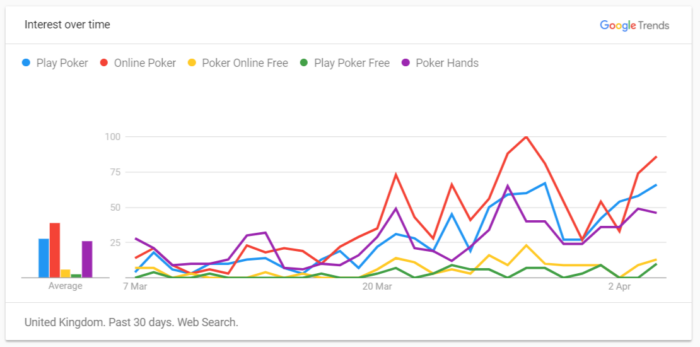
Source: Blueclaw Media
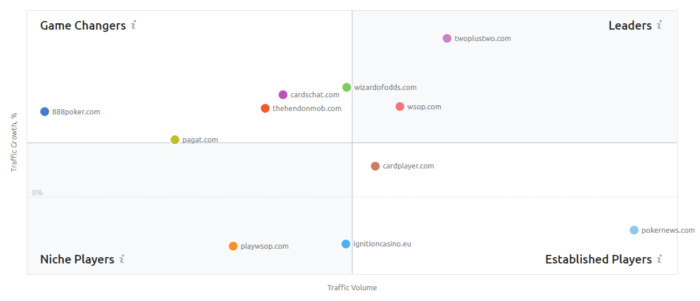
The poker market is, like all gaming markets, very well established. However, our research shows that in the last 12 months several websites have managed to successfully infiltrate the SERP using a combination of Skyscraper Content, aggressive, but organic link building and customer loyalty.
Source: Blueclaw Media
Cardschat.com, for example, has invested significantly in producing content and guides. Their reward is nearly twice the keyword visibility than rivals pokerstars.com, according to SEMrush data.
Short-term pain vs long-term gain
There are far easier ways to generate short-term revenue than SEO. Utilising paid media, social advertising and leveraging affiliate channels will help, but with rising cost per acquisitions, your marketing strategy should include an exit strategy. This involves three consistent improvements across your website:
- Easy-to-read, shareable and informative content
- Inbound PR, links and positive organic link acquisition
- Technical SEO
These services in equal measure, against clear objectives, will support your success in tough times and help to support your business if you are considering a pivot into a new market.

Sam Raife is the senior SEO manager at Blueclaw Media. He has spent the last seven years working with some of the biggest (and smallest) egaming brands worldwide to deliver strategic ROI through SEO.