
Safer gambling group calls for statutory levy to replace “unsustainable” voluntary system
ABSG group expresses “disappointment” that BGC’s £100m funding pledge isn’t linked to wider national strategy


The Advisory Board on Safer Gambling (ABSG) has said progress on the National Strategy to Reduce Gambling Harms will be “limited” without the implementation of a statutory levy on operators.
The group reiterated prior calls for a levy in its report into the three-year strategy, also calling on the Gambling Commission to accelerate delivery of objectives related to the strategy.
“A continuing reliance on a voluntary system, wherever that may be situated is, in our view, not sustainable,” the report claimed.
“Concerns continue about independence, predictability and the quantum of funding, and in the absence of a levy, there are significant limitations on the scale of action that can be taken,” the ABSG added.
However, the ABSG welcomed a £100m funding pledge by the BGC aimed at reinforcing research, education and treatment of problem gamblers through GambleAware, to be delivered over the next five years.
The group said the commitments had the potential to “significantly change” the funding of gambling-related harm treatment efforts in the UK but expressed concern about the “ongoing uncertainty” about timelines for delivery of funding.
“As yet, no new money has been forthcoming. It has been disappointing to see no explicit link in either announcement to the National Strategy itself, nor any mention of the critical need for investment in prevention,” the report said.
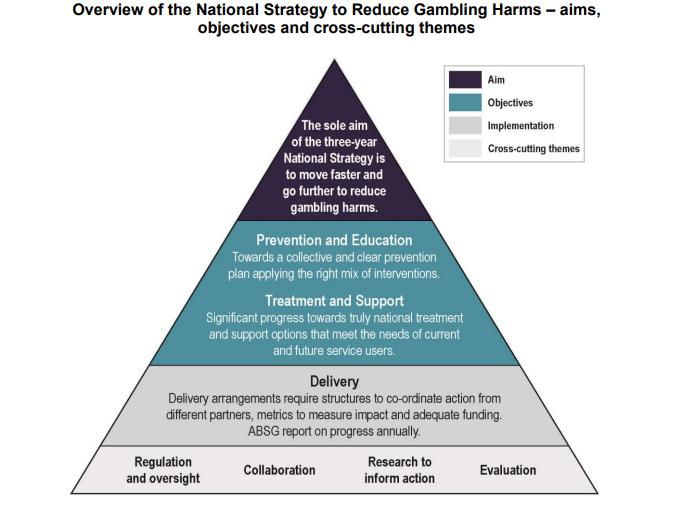
An overview of the three-year strategy
Source: ABSG
The ABSG has said “much more” needs to happen to achieve objectives, citing the need to urgently address the issue of gambling-related suicide.
The group, which was created to measure progress on the strategy, has said a safer gambling league table and key baseline metrics should be established from which to set targets and measure progress.
“Government, regulators, industry, the NHS and third sector organisations should agree areas of responsibility for ensuring these metrics are in place,” the ABSG said in its report.
In addition, the ABSG has said the commission should accelerate efforts to bring in people with experience to assist with the delivery of the strategy, as well as greater collaboration with the academic sector.
“To make faster progress on treatment, the NHS should lead the creation of a national treatment strategy working in partnership with the third sector,” the report recommended.
Last week, the Gambling Commission unveiled its interim experts by experience group, which will assess and make recommendations on the regulator’s proposals for reforming the industry.