
Turning up the volume: 888 chief talks scale, sports and mergers
888 CEO Itai Frieberger sits down with EGR Intel to discuss last year’s unsuccessful bid for William Hill and why the firm’s in-house platform puts it in pole position to capitalise on M&A opportunities


“Bringing volume onto our platform would be a massive shareholder value generator,” Itai Frieberger explains to EGR Intel, as we sit down in London just days before the ICE exhibition.
“It could be William Hill, it could be someone else, it doesn’t matter – the rationale still exists. 888 will be a major player in future industry consolidation,” he adds boldly.
Perhaps understandably, 888’s chief executive is reluctant to talk too much about the M&A failures of the recent past – namely being pipped by GVC for bwin.party and having the door slammed shut in its face by William Hill. But there remains a sense of ruefulness about how the Hills approach, which was pitched in partnership with Rank, eventually panned out.
“I don’t think about it,” Frieberger immediately responds, when asked about the two-party consortium bid last summer, which was swatted away by Hills with little consideration. “I really liked the idea of the three-way,” he adds after a short pause. “There was so much upside when it came to the opportunities we had.”
But how did the idea of a joint bid come about? Who called who? “I honestly can’t remember,” Frieberger says. “Henry [Birch, Rank CEO] and I have a very good relationship, I like him a lot – he’s good fun. We met a long time ago and we said we should do something together but had never done anything. We meet on a regular basis and this is when the idea came up about doing Hills together,” he adds.
Despite the M&A setbacks, Frieberger remains optimistic, if not confident, about the future for 888. The firm continues to grow at a double-digit rate and has, in recent years, zoned in on expansion into regulated markets, all while broadening its product portfolio in those where it is already present.
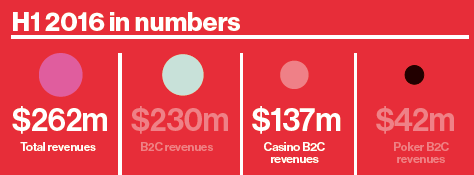
These actions saw H1 2016 revenues grow 19% – or 21% in B2C – while regulated revenues now represent 63% of the whole business. Yet despite these positive numbers, the big prize remains a transformative, or as Frieberger puts it “life-changing”, acquisition.
Pump up the volume
According to Frieberger, the opportunity to put more volume through what he describes as the leading proprietary platform in the industry, is simply too good to ignore. That was the rationale behind the William Hill move – to take Hills’ customer database and port it onto the 888 platform, enabling the firm to deploy its sophisticated CRM tools on Hills’ customers.
“That, in essence, is the idea behind our M&A agenda,” Frieberger says. “Bringing more volume onto the platform would create more value as a result of the protocols we have in place, the algorithms we’ve embedded – everything is automated and the cost of running the platform is relatively stable.
“I guarantee the lifetime values of customers placed on our platform would dramatically increase, end of story.”

888 CEO Itai Frieberger says the firm remains on the M&A hunt
While some of 888’s peers have been mushrooming in size through mergers and acquisitions, the growth experienced by 888 in recent years has been more gradual and via organic means. A key driver of growth over the past few years has come via its sharpened focus on sportsbook.
In 2014, 888 switched from its Blue Square provided platform to one supplied by Kambi, and according to Frieberger, the results are plain to see.
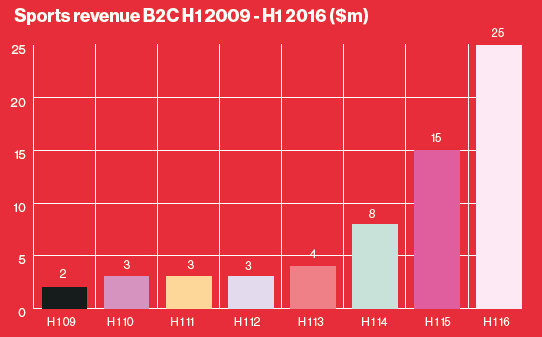
To make his point, Frieberger breaks off briefly from the interview to search for a copy of 888’s H1 report. On re-entering the office, he lays out a results booklet containing a graph which illustrates the impact sports has had since that Kambi integration almost three years ago. In sports alone, revenue has increased from US$8m in H1 2013 to H1 2016 $25m, the latter representing a year-on-year rise of 63%.
Increasing value
But it’s the ancillary benefits the product brings to its flagship casino business that excites Frieberger most. He explains that wherever 888sport has been launched – Italy, UK, Spain – the 888casino business receives an immediate and continued boost. H1 2016 casino revenues grew by 31%, a remarkable hike.
The chief exec says this is because 888 remains one of the best in the business at acquiring customers, cross-selling into casino, and using its CRM and bonusing techniques to keep players active longer, thereby increasing LTVs as a result.
“At the end of the day, this business is a very simple business,” Frieberger says. “The LTV of a customer and the CPA of a customer will tell you how well you are doing. So if you don’t know how to acquire customers and you pay a lot for acquisition you will lose money.
“But if you increase LTV you could get there,” he adds. “Increasing LTV can come from a number of different areas; firstly cross-sell, then retention, increased conversion – so when you have a customer coming to the website, making sure they deposit money.
“The more you lose customers in the funnel, the more money you lose and that makes CPAs higher. That is the whole game. If you can’t grow LTV you are dead in the water.”
“The more effective at this you are, the more the LTV a customer will have. The more you lose customers in the funnel, the more money you lose and that makes CPAs higher. That is the whole game. If you can’t grow LTV you are dead in the water.”
Frieberger’s eyes light up when he says 888sport holds around 1% market share in the UK, with headroom in sportsbook in tandem bringing growth opportunities in casino. “That makes sports a massive opportunity,” he says.
It’s also an opportunity he admits 888 was slow to react to, having previously been focused almost exclusively on casino and poker. “That was an historical mistake, which we are correcting,” he says of the firm’s earlier laissez-faire attitude to sports.
Frieberger says the firm is still playing catch-up in sportsbook and remains in the process of building the betting culture required to be successful in the vertical. “We don’t have the DNA yet,” he says.
“We are still in the process of acquiring it. It’s a difficult and long process – although if we were successful last year with William Hill, we would have acquired it,” he adds.
Flying solo
Yet the bigger 888sport grows, the more it pays out to its supplier – which isn’t really the way the company likes to operate. This distribution of cash was one of the primary reasons 888 decided to take the long route to mobile a few years ago, deciding to build its own technology rather than take an off-the-shelf solution.
“We moved into mobile relatively late and the press were telling us we were slow as we didn’t take a product from a third-party,” Frieberger recalls. “But we built three verticals from scratch into mobile – it took time but it is part of who we are. Owning our own products and developing our own products is part of our longer-term strategy.
“If we had taken a third-party mobile product we would have become stuck,” he adds. “Not just the fact that it was a fast growing channel and we wouldn’t have had control, but we would have been on a rev share, so having our own product means we are more operationally geared.”
So does this mean its days with Kambi are numbered? Frieberger says not, admitting his firm isn’t in the right place to run its own sportsbook business right now, while in turn praising its current provider. But the reality is that, and as previous M&A attempts go to show, the long game is for 888 to be in full control of its own sportsbook.
“I don’t feel right now that the company is prepared to run its own sportsbook,” Frieberger says. “Kambi is a great provider – a tier one provider with a differentiated product and we feel very comfortable and have a very good relationship with them,” he adds.
“The product is not something that stops us from achieving our goals. We are very far from using the capabilities of the product – like everything, it has its flaws, but we are working with Kambi as we go along and the product is becoming better and better.”
Facing headwinds
Despite recent international diversification, the UK remains 888’s largest market by far. Frieberger puts it at around 46%, which is one of the reasons why the firm faced a number of downgrades by City analysts ahead of the introduction of the Point of Consumption tax at the end of 2014.
Its share price since the implementation of the tax is testament to how the firm negotiated that tricky hurdle, with it rising from a low of 114p in 2014 to 234p at the time of writing.
And in months to come, 888 and its gaming rivals will be given yet another tax increase to negotiate. The UK government’s decision to bring gaming in line with sportsbook and apply a tax to bonus plays is yet another external pressure likely to squeeze margins further.
Dubbed ‘PoC2’ by many, Rank CEO Henry Birch recently estimated that the new levy, due to be introduced in August, would set his firm back in the region of £3m per annum should it make no amends to its marketing strategy. And Paddy Power says it will face a £6m per year hit.
Operators will be sure to alter their approach to bonuses in an attempt to blunt the tax’s impact and Frieberger says 888 is already trialling alternative acquisition and retention techniques to reduce the operator’s reliance on free plays.
“Absolutely, we are trying things – every pound counts,” he says. “We have different ways of incentivising our customers and we are checking different bonus schemes and incentives but I can’t tell you any more than that.
“We have a special team here, just like we had for the first PoC, which is responsible for how we need to alter the business in order to deal with the tax changes,” Frieberger adds. “This is what they do and they are working on a few ideas. Some are being tested and some will be launched soon.”
Frieberger is keen to highlight the fact that this kind of flexibility and agility is only possible because of the firm’s proprietary platform. “It’s just another upside for owning your own platform,” he says.
“It allows you to make these kind of changes. Of course a platform costs money but enables you to differentiate, allows to mitigate challenges and react to certain opportunities. We can play with our platform and amend it as we see fit,” he adds.
The chief exec, who officially assumed the role last May as predecessor Brian Mattingley moved to the position of chairman, described the need to adapt to the ever changing landscape as “exhausting”.
“Every year something seems to happen,” he says. “This year it is PoC2, last year it was Brexit – this was dramatic for us as we report in dollars – and the year before that it was PoC.”
Reaching out
There is also the ongoing Triennial Review into FOBTs, which is expected to report in the spring. The widely held view is that the UK government will significantly reduce maximum stakes from £100 – potentially to as low as £2 per spin.
This lingering doubt means, according to Frieberger, that M&A involving any firm with a significant retail base is on hold until the results of the review are known.
“M&A is at a standstill because of the FOBTs – without knowing what is happening, you can’t put a value on the bookies,” Frieberger says. While the results of the review will have no direct impact on 888’s online-only business, some believe a heavy-handed stakes reduction could encourage the retail giants to put even greater efforts into transitioning players to the less restricted online environment.
“If this happens, it would present an opportunity for us,” Frieberger believes.
“Mainly because we are better online so if there were an increasing number of retail customers moving to online, then I am confident we could win them.” He concedes this could eventually lead to staking restrictions of some kind online, but says the firm is perhaps better placed than some of its rivals to operate in a heavily regulated environment.
“M&A is at a standstill because of the FOBTs – without knowing what is happening, you can’t put a value on the bookies.”
And winning new customers is an art 888 appears to major at. Frieberger says the firm is using digital marketing techniques not widely used in the industry, but have been leveraged successfully in other ecommerce sectors.
“We can go beyond 888 parameters to communicate with our customers,” he says.
When asked to give an example, he pauses, cautious of giving away any commercially sensitive information. “I can’t really give specifics for obvious reasons,” he says. “But we are beyond everyone else – they are picking up but they are not catching up as we continue to move forward too.”
Frieberger eventually cracks and gives the example of retargeting – using online ads to bring back customers who may have visited 888 but not interacted for whatever reason. “We use this a lot – we are very advanced in it,” he says.
The firm’s marketing costs in H1 2016 increased from 31% of revenues to 34%, with much of that increase the result of the firm’s sports betting push, particularly around the European Championships – a major tournament Frieberger says 888 was able to compete in for the first time in a marketing sense.
The result of that investment at a B2Cwide level was a 22% YoY increase in first time depositors during the first half of last year. And the firm continued its marketing push in H2, again with sport a major focus, signing major sponsorship deals with four Championship football clubs and launching a new TV campaign.
Sliding doors
Of course, things could have been so different had William Hill succeeded in its bid for 888 just two years ago. In 2015, under the stewardship of James Henderson, William Hill offered approximately 210p per share for 888, which valued the business at around £750m. However, the offer was rejected by, among others, 888’s major shareholder, who was holding out for a higher offer.
And Frieberger says history has proven the rejection of that proposed deal to have been the right move. “When the shareholders came under serious scrutiny for not selling to William Hill two years ago, some sections of the press were saying “you cannot deal with 888 because of their shareholders”,” he recalls.
“A few months later the share price went up to the price the shareholders were asking for, so it was definitely the right decision not to sell when we were confident we would get to that price level a few months down the road.
“Perhaps if Hills had paid a little bit more they may have avoided other things happening later on,” he adds.
The fact 888 last year found itself in the hunt to acquire, rather than be acquired by, William Hill, is both testament to the work it has undertaken in recent years, and a reflection of the difficulties experienced by the UK bookie.
That’s not to say 888 doesn’t remain an acquisition target itself, but the firm’s immediate desire is to continue growing the business while keeping a beady eye on the M&A scene.
Growth within Europe remains 888’s primary focus – the operator has seven licences on the continent and harbours plans to enter the Netherlands upon regulation in the next 12 months, while countries like the Czech Republic and Portugal remain on its radar.
Its progress in Europe stalled in 2014 and 2015 as its attention, and investments, turned to the seemingly regulating US. But with just three states in play and the prize market of California at a regulatory deadlock, the US is now firmly considered a long-term play.
However, Frieberger says the firm will retain a presence in America, hoping that one day the market will take off. “When it does open up, 888 will be in a very strong position to capture significant market share,” he says.
“Although I’m not sure when that will happen. It’s like asking whether a year from now it’s going to be a rainy day or sunny day – I’ll assume a rainy day,” Frieberger jokes.
In the meantime, the firm will focus on increasing the volume on its platform, while searching for that ‘life-changing’ transaction which could really shake up the market.