
Some key questions from 888’s record financial penalty
EGR Intel looks at what yesterday’s ruling on the operator's self-exclusion failings means for the rest of the industry


The UK online gambling industry was once again thrown under the media spotlight yesterday – and unsurprisingly it was for all the wrong reasons.
This time is was 888’s turn to face the music. The Gambling Commission announced it had handed out a £7.8m financial penalty to the operator for “serious failings” in its handling of vulnerable customers.
Technical failures in 888’s systems had led to more than 7,000 customers who had previously self-excluded from casino/poker/sport still being able to access bingo, which is run on a separate platform. As a result, the group of customers deposited a further £3.5m and staked more than £50m.
Below, EGR Intel looks at some of the key questions arising from the case.
How does the financial penalty compare to previous rulings?
One of the Gambling Commission’s highest penalties up to that point was when Betfred last year agreed to pay more than £800,000 for AML breaches after it was found one of the operator’s VIP customers had been allowed to bet using money stolen from their employer.
More recently, the regulator also handed down its first financial penalty for advertising failings after fining BGO Entertainment £300,000.
The 888 case, in comparison, will see the company hand over a record £7.8m. This includes £3.5m of deposits made by the self-excluded customers and an additional £4.25m for socially responsible gambling causes.
But a number of industry experts weren’t particularly surprised by the seven-figure sum. “There are other agencies looking at the industry like the ASA, ICO and the CMA, but the one thing the Gambling Commission is solely responsible for is social responsibility and all the things that flow from that,” one lawyer told EGR Intel.
“One of the flagship regulatory requirements has to be self-exclusion and if an operator haven’t taken steps to ensure self-excluded players aren’t excluded from their business entirely, then I think it’s pretty much as bad a regulatory breach as you can get. So I’m not surprised they’ve had the book thrown at them.”
What did 888 know and what steps has it taken since to fix the issue?
888 voluntarily notified the Gambling Commission of the issue back in February. But according to a source close to proceedings, the company has taken significant strides to ensure such mistakes are not repeated and has used the review as an opportunity to invest heavily in other critical compliance areas.
“888 has learned from its mistake and made significant changes to its systems and algorithms,” they told EGR Intel.
“So its changed a lot in the way it handles compliance and regulation. It has also added some additional safety checks so that even if it has these or similar issues in the future, hopefully it will be able to track them a lot sooner.”
Why did 888’s share price soar yesterday?
The market reaction to yesterday’s news seemed to tell a very different story to the narrative in the national press. 888’s share price on the London Stock Exchange started the day on 250p but within an hour had jumped to 266.25p – one of its biggest increases in months and its highest level since June.
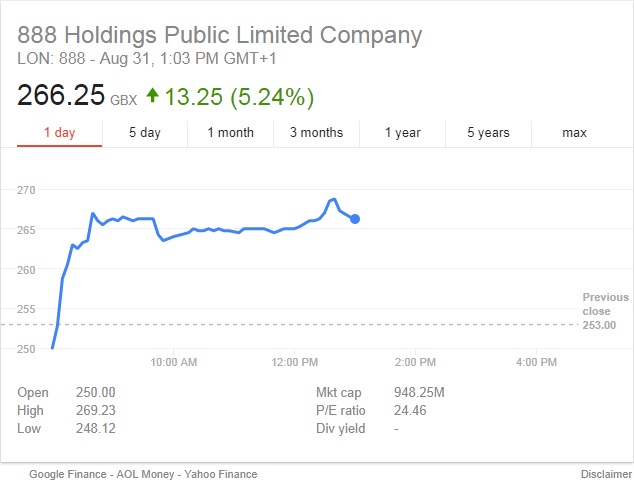
So why did this happen? Markets clearly don’t like uncertainty and after months of its licence being under review, 888 had escaped the worst possible outcome of having its licence either suspended or revoked.
Was its licence really under threat?
The Gambling Commission said in a radio interview yesterday morning that although 888 had paid a big financial penalty, the regulator has more drastic weapons it can use in future – and those tools are around licensing. A number of sources told EGR Intel yesterday that the seriousness of the investigation meant there was a genuine fear 888 could face repercussions surrounding its licence.
However one source familiar with the matter claimed this was still an unlikely outcome. “I don’t think a licence revocation or suspension was ever going to happen – that would have been a very disproportionate response because even though it was something very serious, it was actually a relatively narrow issue.”
What comes next for 888 and the rest of the industry?
888 has agreed to an external audit of its self-exclusion processes following the decision. EGR Intel has learned the firm has already undertaken internal audits ahead of this occurring, in addition to beefing up its internal reporting systems.
A source familiar with the matter told EGR Intel: “I’m not saying the business is bullet proof now and that nothing can happen, but 888 wants to be in a situation that if something happens again, it can be confident to sit in front of anyone and to say it thinks it has done enough.”
But what about other operators? Are they also under threat? EGR Intel understands that other operators are currently under investigation by the Gambling Commission – although this is not necessarily focused exclusively on self-exclusion measures.
And while the £7.8m figure might feel like a hefty fine, it seems the Gambling Commission is still after a big scalp. Could it come in the form a licence suspension or revocation? “It wouldn’t surprise me if that does happen at some point,” the egaming lawyer told EGR, “but with a smaller operator where there might be more systematic failures across a number of areas. I think the Commission has an appetite to do that to make a real point.”