
Removing the stigma of ICOs
Despite egaming having raised over $460m from ICOs, this method of fundraising has developed a shady reputation. However, CashBet has leveraged major marketing opportunities to help improve the perception of token sales


ICO is a term that first came to light in the wake of the blockchain boom a few years ago. Yet although initial coin offerings (ICOs) – the blockchain equivalent of the traditional means of raising capital via an IPO – have had particularly bad press in the past, they are fast becoming an intelligent and secure means of raising capital. Indeed, blockchain-powered tech start-ups and those offering tokens as currency to use within their products are also turning to ICOs as a way to build a brand reputation.
Within the gambling industry, more than 60 ICOs have raised in excess of $460m in the past couple of years, SolutionsHub founder and consultant Lee Hills tells EGR Technology. And according to a PwC study, approximately $13.7bn was invested in ICOs across the entire tech sector in 2017. In the past, the egaming industry, among others, shunned ICOs for being an unregulated and illegitimate means of raising funds. And after a few fake launches were brought to light, a widespread belief that ICOs were a scam flooded the internet and the press.
But regulators are quickly warming to the idea of ICOs. In the last year, egaming hubs Gibraltar, Malta and the Isle of Man have scrambled to formulate viable regulatory frameworks to support businesses and their desire to source investment. Hills touches on the use of ICOs for anonymous gambling. “These models will not be able to scale or deliver value to token holders. They will not gain mainstream credibility or legal market access, and the operation will likely form a criminal enterprise, resulting in prosecutions, fines and custodial sentences,” he notes. But beyond this, he believes ICOs are being used for the greater good.

Mike Reaves, CEO of CashBet, says the firm’s ICO has allowed it to inject money back into developing the technology further
Dr Joseph Borg, a partner at Maltese law firm WH Partners, has been leading the move to welcome blockchain businesses to the Mediterranean island. “ICOs are a more modern and smarter way of raising capital for start-ups,” he says. “They started as a way for developers and inventors who come up with a solution for a problem, based on blockchain technology, to raise funds to create their idea while giving the contributors the possibility to be the first to make use of their invention. This allowed them to maintain control of their invention and not succumb to banks and venture capitals.”
Hills is of the opinion that the wider crypto market has responded “incredibly positively” to the move to regulate and seek mainstream adoption in the Isle of Man, where his company is striving to become the leading authority on crypto and blockchain gambling licensing. “It is imperative that any ICO engages with regulation and does not ignore or circumvent it.
“This includes ensuring tokens are sold in jurisdictions [where] it is legal to do so, verifying purchasers in compliance with international anti-money laundering and counter-terrorist financing standards, accounting properly for cross-border transactions, utilising the best corporate vehicles for the individual project and protecting/utilising data,” Hills comments. He urges companies to take a stringent approach to compliance in whichever markets they are looking to establish an ICO. From his perspective, the regulatory process is much simpler than that of the company launching the coin offering.
In the money
One of the more successful and widely discussed egaming ventures to raise funds via an ICO is FunFair, former PKR founder Jez San’s casino technology platform which offered the first insight into how blockchain technology and virtual currencies could be securely used in online gambling. He launched his ICO for the FUN token last July and raised $26m in the first round of investment. Then, in October, US-based esports betting platform Unikrn raised over $30m in its ICO with Unikoin Gold, including financial backing from the likes of Hollywood actor Ashton Kutcher and Australian gaming giant Tabcorp.
By Q4 2018, the blockchain hype was in full force and, most recently, UK-licensed blockchain betting firm CashBet beat all industry records in securing $38m in its token sale earlier this month. In the run up to the process, the company tirelessly marketed its brand and secured the first major sponsorship by a crypto company with Arsenal Football Club. “Our process started about a year ago when we were sitting in a boardroom and looking at the future of the company and how we were doing,” CashBet founder and CEO Mike Reaves says.

Lee Hills of SolutionsHub advises firms looking to initiate an ICO on how to approach the process in a regulatory-sound way
“We are different than most ICOs in that we have an established business. CashBet is five-and-a-half years old and we [were] really looking to expand the business and differentiate ourselves from the other platforms out there. It was apparent we needed some sort of a differentiator and more capital.” An integral part of the process is establishing a white paper, which Reeves says should outline “the industry you’re in, the problem the industry is facing, what challenges are coming in the future and how the company could address that with blockchain and our product”.
Once the ICO is launched, investors are able to invest fiat money in exchange for whatever token has been established by the start-up. Hills says there are two types of ICOs in the betting industry – the first being the crypto betting ICO, like Unikrn and CashBet, which establishes a tokenised offering that will enable users to place bets on the platform using its decentralised monetary value. Blockchain gambling is the second variation of an ICO, says Hills, and like FunFair, it utilises the technology to underpin the gambling mechanism, making all bets auditable.
Hills advises early-stage ICO adopters to consider their company’s “team capabilities”, including its advisors. “When reviewing ICOs one should ensure the ICO is supervised by a strong financial services or securities regulator,” he reveals. Reaves agrees vehemently, insisting that is exactly why CashBet sought the legal advice of reputable global law firm, Paul Hastings. And with the firm’s experience in securities and the Security Exchange Commission, Reeves believed it suited the task at hand. “The team there were familiar with the process and the various files and exemptions.”
Elsewhere, Reaves says an ICO is the digital equivalent of casino chips, and CashBet has taken its token offering one step further by signing a partnership deal with crypto lottery-betting operator CryptoMillionsLotto. The move will see the company provide its CashBet Coin as the exclusive token on the operator’s platform, which enables users to place bets on the outcome of the German National Lottery.
Reaves alludes to the numerous advantages of developing an Ethereum-based utility token that can be used on other platforms. One example is a series of features within the token’s smart contract that has enabled the firm to add functionalities that include a VIP loyalty programme. This has already been adopted by supplier Novomatic. Reaves adds: “There’s been a huge benefit in developing feature functionality around that token as we’ve gone through the ICO process. We’re able to achieve a greater level of awareness by getting this payment out there to different operators and the ICO allows us to continue to put money into the company’s treasury and develop these interesting features.”
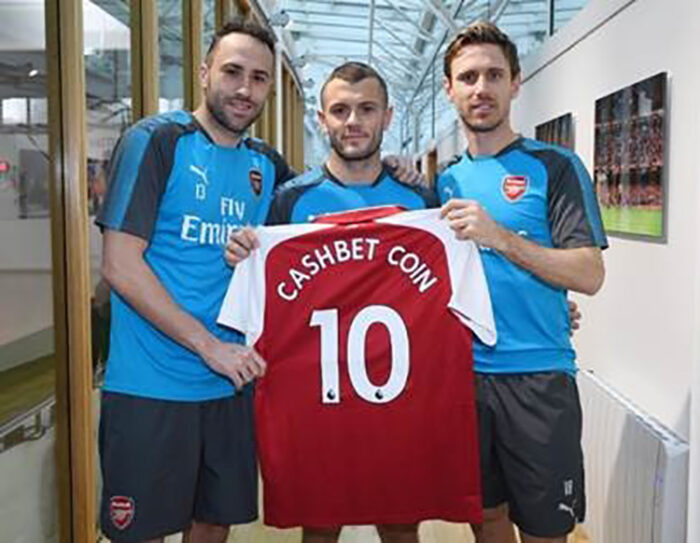
Earlier this year CashBet signed a lucrative sponsorship deal with Arsenal FC in an effort to reach a broader spectrum of investors ahead of its ICO
CashBet’s tireless marketing strategy has helped to expel the negative stigma attached to ICOs and the crypto industry in general. And according to Reaves, extensive analysis and research ahead of the launch swayed the company’s board to support its efforts. “We thought then we had a real opportunity to bring legitimacy to the ICO process. We wanted to make sure there was transparency and legitimacy to everything that we did here.” He maintains that the perception of ICOs overall has certainly shifted and the industry is no longer the ‘Wild West’ it once was.
Wider interest
Jurisdictions are now battling it out to offer the most competitive regulatory framework for these tech start-ups in the preliminary stages of considering an ICO. Hills says the Isle of Man was the first to approve a fully decentralised gambling model and has been actively working with operators and ICO organisers. Elsewhere, Dr Borg says Malta is in the process of debating proposed laws in parliament, but the Financial Services Association will soon be capable of approving ICOs once laws are in place. Gibraltar rolled out what it claims to be the first ICO specific regulations in February after a thorough public consultation process on financial services and fintech companies operating via crypto technology.
The regulation establishes disclosure rules that require adequate, accurate and balanced information for anyone buying tokens. “One of the key aspects of the token regulations is that we will be introducing the concept of regulating authorised sponsors who will be responsible for assuring compliance with disclosure and financial crime rules,” Siân Jones, a senior adviser to the Gibraltar Financial Services Commission, told Reuters at the time. In his budget speech earlier this month, Gibraltar’s minister for gaming revealed the online gambling division was working with the Financial Services Commission on cryptocurrency proposals and that gambling start-ups could support the Gibraltar economy. And when the regulatory giants start to sit up and take notice, it becomes clear crypto and ICOs are on their way into the mainstream.