
Pressure situation: The under-fire UK Gambling Commission feels the strain
The high-profile collapse of Football Index has led to accusations that the UKGC was “asleep at the wheel”. But where does this leave the beleaguered regulator as Neil McArthur heads for the exit?


When Neil McArthur was appointed from within as chief executive of the UK Gambling Commission (UKGC) in April 2018 following Sarah Harrison’s departure, his quote in the press release insisted that he was “looking forward to the challenge”, there was “a lot more to do” and that he would be “tough but fair” with operators. While it is debatable whether those were his own words and not a quote manufactured by the PR department, it nevertheless spoke of a man keen to stamp his mark on this non-departmental public body, as well as tackle the gambling industry’s shortcomings around protecting vulnerable players and repair its tarnished reputation. A shade under three years later and the UKGC issued another press release on 15 March, this time revealing McArthur’s sudden departure after almost 15 years at gambling’s watchdog (he joined in 2006 as general counsel). No explicit reason for him stepping down was given, yet the brief quote on behalf of McArthur said that with the government’s review of the gambling act underway “now feels the right time to step away and allow a new chief executive to lead the Commission on the next stage in its journey”. That in itself is a curious reason given the wide-ranging review could lead to profound changes to the industry and gambling laws. On top of this, the timing is peculiar seeing as the UKGC is handling the tender process for the fourth National Lottery licence. The third is due to expire in 2023. The speculation is that he fell on his sword due to the Football Index scandal – potentially the largest UK gambling company collapse ever – and subsequent media storm where the under-fire UKGC was accused of being “asleep at the wheel” by Clean Up Gambling founder Matt Zarb-Cousin. While the timing hardly seems a coincidence, it is just that: speculation. “We don’t know why Neil did resign – the only thing we know is that the reason given by the Gambling Commission is likely to be untrue,” suggests Dan Waugh of Regulus Partners. “The claim that you change the chief executive because you’re in the middle of a gambling act review is clearly nonsense. You need some degree of stability, so the resignation is clearly not for the reasons given by the Gambling Commission.” David Clifton, director of Clifton Davies Consultancy, was taken aback by the rapid exit of the chief executive, who he describes as a “very careful thinker who took his responsibilities extremely seriously”, from the regulator’s HQ at Victoria House in Birmingham. “More than anything else, it was the timing of Neil McArthur’s departure with immediate effect that surprised me,” he says. “I might instead have expected him to stay in post throughout the government review of the Gambling Act 2005 in order to argue the Commission’s case, more daunting though that may have become given the widespread criticisms of the regulator arising from the recent collapse of Football Index.”
The big crash
Football Index’s demise has left the UKGC looking, at best, negligent and, at worst, inept. In fact, Adam Cole, the CEO and founder of this self-styled football stock market, claimed the regulator didn’t have a grasp of how the business worked when he appeared on a Football Index-related podcast last June. “We are a completely unique product. To be honest, the Gambling Commission doesn’t fully understand the ins and outs of our business model and our platform.” He followed up that condescending comment by saying that Football Index had become a “tier-one operator” and with that came an “enormous amount of compliance scrutiny”. We now know the UKGC began a formal review into BetIndex (the trading name of Football Index) in May 2020 with the help of a “specialist external QC” and a forensic accountant to examine its business model, its finances, and questions over the appropriate regulatory framework. And yet Football Index was allowed to continue operating as die-hard evangelists and new users ploughed considerable sums into the platform based in the British crown dependency of Jersey, which meant its financial stability was concealed. The removal of the ability to instantly sell shares back to the firm in 2020 and the introduction of order books to make it function more akin to a financial stock market was the beginning of the end as it triggered market crashes. People’s portfolios plummeted in value as there weren’t enough users on the buy side to prop up the market. Then, in February, management announced they were slashing dividends (pay outs in pennies per ‘share’ for on-field performances and media coverage) in April, effectively altering the terms and conditions of the bet. Customers were up in arms. Shortly after, the company was forced to call in the administrators and the UKGC suspended BetIndex’s licence in tandem with the regulator in Jersey where it also holds a licence. Football Index has been compared to a Ponzi scheme in that it needed a constant supply of new customers to keep paying out dividends to existing users, an allegation BetIndex has vehemently denied. Leigh Day, the law firm working alongside Clean Up Gambling to investigate potential legal claims against Football Index and its creators, said the role of the UKGC will come under scrutiny and that “serious questions will need answering”. “People were warning them [the UKGC] for many months about Football Index,” says Brian Chappell, founder of Justice for Punters, who accuses the UKGC of consistently employing “light-touch” regulation. “If they’d acted quickly by freezing company assets and temporarily closing the platform, people would have had a far better chance of getting their money back.” Because these ‘shares’ in football players ‘minted’ by Football Index was a three-year bet on whether the value would go up and the amount of dividend pay outs, the product was regulated by the UKGC. It was a synthetic stock market and so didn’t fall under the remit of the UK’s financial regulatory body, the Financial Conduct Authority (FCA). Yet that operator licence from the UKGC, along with the Football Index advertising on TV, radio, the outside of black cabs and across the shirts of Championship clubs Nottingham Forest and QPR, added credibility to the platform. People trusted it enough to ‘invest’ their life savings in some instances. The Times reported total “losses” run to nearly £90m.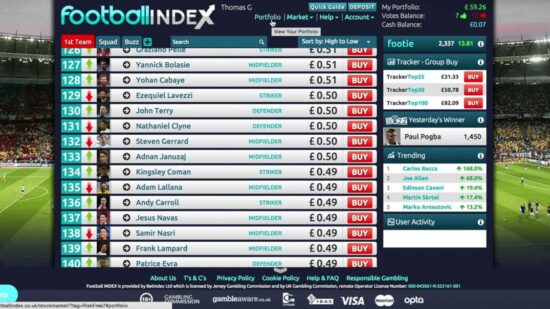 “The UKGC has been seized upon as the obvious scapegoat by critics of the gambling industry and customers left out of pocket alike,” says Clifton. “The position has not been assisted by the belated revelation that a formal operating licence review was started by the Commission as long ago as May 2020, which has involved in-depth examination of the Football Index business model and its finances by forensic financial accountants, two regulatory bodies and a QC. In those circumstances, one can understand why people are asking why something was not done earlier instead of what will seem to many to have been regulatory action well ‘after the event’.”
He adds: “As it stands, we don’t know enough about the reasons for commencement of the operating licence review, but if it transpires that aspects of the Football Index business model did not constitute gambling and, for example, should instead have been regulated by the FCA – an idea that was apparently explored in October last year – then fundamental regulatory questions will arise.”
Meanwhile, those users with funds in another start-up, Footstock, which billed itself as a cross between fantasy football, investing and collectable card games, face an anxious wait to see if they will see their money again after it collapsed in the wake of Football Index’s high-profile implosion. Much like Football Index, anger among Footstock users on social media was aimed at the UKGC for what they perceive to be a lack of regulatory oversight.
There have been a number of betting companies down the years that went to the wall and took with them customers’ funds. BetBright and MoPlay being two notable examples. Regulations state that remote operators must hold customers’ money in a separate account, yet this does not automatically guarantee the money will be refunded if the firm goes bust as the level of protection varies between operators. Iron-clad ring-fencing of players’ funds seems an obvious, and overdue, addition to gambling laws.
While Richard Williams, a specialist gambling, licensing and regulatory lawyer at Keystone Law, acknowledges that consumers need to take more responsibility for their own actions, including not putting life savings in a betting product, he believes the regulator should act quicker. “The Commission should step in a lot earlier in future, unless businesses can show they are sustainable. This wouldn’t solve all of the problems, but it would help. We can’t have these high-profile failures continuing to happen, as people will lose all trust in gambling operators.”
“The UKGC has been seized upon as the obvious scapegoat by critics of the gambling industry and customers left out of pocket alike,” says Clifton. “The position has not been assisted by the belated revelation that a formal operating licence review was started by the Commission as long ago as May 2020, which has involved in-depth examination of the Football Index business model and its finances by forensic financial accountants, two regulatory bodies and a QC. In those circumstances, one can understand why people are asking why something was not done earlier instead of what will seem to many to have been regulatory action well ‘after the event’.”
He adds: “As it stands, we don’t know enough about the reasons for commencement of the operating licence review, but if it transpires that aspects of the Football Index business model did not constitute gambling and, for example, should instead have been regulated by the FCA – an idea that was apparently explored in October last year – then fundamental regulatory questions will arise.”
Meanwhile, those users with funds in another start-up, Footstock, which billed itself as a cross between fantasy football, investing and collectable card games, face an anxious wait to see if they will see their money again after it collapsed in the wake of Football Index’s high-profile implosion. Much like Football Index, anger among Footstock users on social media was aimed at the UKGC for what they perceive to be a lack of regulatory oversight.
There have been a number of betting companies down the years that went to the wall and took with them customers’ funds. BetBright and MoPlay being two notable examples. Regulations state that remote operators must hold customers’ money in a separate account, yet this does not automatically guarantee the money will be refunded if the firm goes bust as the level of protection varies between operators. Iron-clad ring-fencing of players’ funds seems an obvious, and overdue, addition to gambling laws.
While Richard Williams, a specialist gambling, licensing and regulatory lawyer at Keystone Law, acknowledges that consumers need to take more responsibility for their own actions, including not putting life savings in a betting product, he believes the regulator should act quicker. “The Commission should step in a lot earlier in future, unless businesses can show they are sustainable. This wouldn’t solve all of the problems, but it would help. We can’t have these high-profile failures continuing to happen, as people will lose all trust in gambling operators.”
Reputation management
Speak to those who regularly deal with the UKGC and there seems to be a common opinion that McArthur wasn’t as approachable a leader compared with his predecessor, Harrison, who Clifton describes as a “tough act to follow”. Nor for that matter Jenny Williams, chief executive between 2004 and 2015. The general feeling was that the UKGC began talking at licensees rather than communicating with and listening to them under McArthur’s tenure, while the hefty penalties handed down to operators for regulatory failings around the time of McArthur’s appointment reinforced that view and did little to ameliorate frayed relations. There was a total of nine penalties amounting to £19.6m (average of £2.2m per penalty) in the period 2018-19 as the UKGC began to bare its teeth. And since 2017-18, the tally amounts to over £100m in penalty packages and 10 operator licences revoked. Only last month, Casumo was hit with a £6m financial penalty over historic anti-money laundering and social responsibility failings, while InTouch Games was slapped with a £3.4m fine for similar offences. Williams says: “During Neil McArthur’s time, the Commission has shown that it’s no walkover and he will be remembered for picking up the pace on regulatory enforcement, licence reviews, financial penalties and also for focusing on responsible gambling. He has to be applauded for prioritising consumers, but this has come at the expense of making the industry the enemy. Relations between operators and the Commission are at an all-time low.”
Neil McArthur, UK Gambling Commission