
How Paf’s stance on responsible gambling is influencing the company’s direction of travel in the online gambling space
EGR Compliance chats to Daniela Johansson, chief responsibility officer for Åland-based operator Paf, about its attitudes to responsible gambling and the effect it has on the wider business


Åland-based operator Paf is perhaps unique in the egaming industry in that it has shown that state-run gambling firms can operate within the governmental structure without those structures becoming shackles. As part of its government ownership, Paf provides annual contributions to a range of projects within health, culture, education and sustainability.
In recent years, Paf has also won plaudits among the gambling community for its approach to responsible gambling. This has seen the firm introduce a loss limit for its players of SEK300,000 (€30,000) per year in March 2018, something which has impacted the firm’s profits by almost €4m.
Earlier this year, the firm again hit the headlines when it called for transparency from gambling operators and took the decision to reveal its players wins and losses for 2017 and 2018. Paf has also recently said it will reduce its loss limit even further to €25,000.
Paf chief responsibility officer Daniela Johansson explains the Paf philosophy on responsible gambling to EGR Compliance and how this might lead to a more transparent and publicly accountable gambling operator.

Daniela Johansson, Paf chief responsibility officer and deputy CEO. Photographed at Paf head office in Mariehamn, December 2018. Photograph: Rob Watkins/Paf
EGR Compliance: To what extent does having government oversight of the Paf business impact the business’ approach to responsible gambling?
Daniela Johansson (DJ): We do believe that government oversight is crucial for the gaming industry, especially with regards to responsible gaming. The gaming industry will never go all the way itself and impose strong enough responsible gaming measures, since it would affect business revenues too much. But governments can set the rules, establish a strong regulatory authority with the mandate to control and penalise gaming companies that don’t follow the responsible gaming standards. This will enhance the public trust in the gaming industry and make all gaming companies compete within the same scope. Since Paf only operates in regulated markets, we always have government oversight and that will always have an impact on our responsible gaming measures.
EGR Compliance: How does being state-owned affect the way the business views corporate social responsibility?
DJ: We are a company with a mission to generate profits for the benefit of society and in that sense we have a really strong mandate to not cause society harm with our products. This is not only affecting our view on social responsibility, it makes Paf what we are today and so corporate social responsibility is at the core of our business strategies. That said, we have made mistakes in the past, we are not perfect. But we are working towards becoming the most responsible gaming company in the world, a vision that our owners fully back up, even if it means they will get less profit from us.
EGR Compliance: Paf CEO Christer Fahlstedt recently described voluntary gambling limits as “worthless”, how important to you as a business is it that your CEO understands responsible gambling?
DJ: It is essential that our CEO understands responsible gaming, otherwise he would not be the CEO of Paf. Christer was quite forthright in his views about voluntary gaming limits, but he is also correct. Research from Stockholm University has proven that voluntary gaming limits have no effect on gaming intensity. That’s why we have also chosen to decrease our yearly mandatory loss limit to €25,000. Voluntary limits are still only voluntary and probably good for a small number of players. But our mandatory limit has an absolute effect on gaming behaviour and it safeguards problem gamblers so they can at least have the opportunity to bounce back in life, before they have lost everything and everyone.
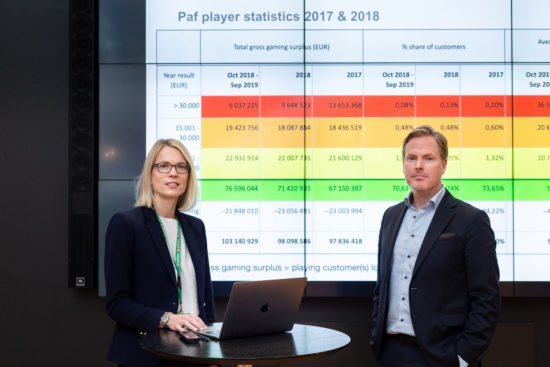
Paf CEO Christer Fahlstedt and Paf deputy CEO and chief responsibility officer Daniela Johansson at Paf head office in Mariehamn with the most recent Paf player segment numbers, 2 October 2019. Photograph: Rob Watkins/Paf
EGR Compliance: What part does the Paf board play in determining the company’s strategy on responsible gambling?
DJ: The Paf Board has adopted and approved Paf’s vision and strategy together with some strong statements related to responsible gaming. We have high ambitions and responsible gaming is clearly visible in all of our daily actions. We take conscious decisions about how we generate our revenue with this in mind. As a realisation of those statements, we no longer accept revenue from high rollers and we have stopped all direct marketing towards players in our risk segments.
EGR Compliance: Paf’s mandatory loss limits are known throughout the industry and have won the business many plaudits, why do you think other businesses have not chosen to make their own limits mandatory to follow its example?
DJ: Gaming companies would lose a lot of money if they adopted a mandatory limit similar to Paf’s and of course they are hesitating to implement something that would hurt their revenues. A limit of €25,000 is really high and almost ridiculous to speak about if you ask the general public, but in the gaming industry we know what it means. The big players and the problem gamblers have a huge impact on revenues.
Some companies might argue that there are players who can afford to play and lose a lot of money, but come on, are they seriously trying to protect the rights of a few millionaires to spend their money on gambling? And at the same time, they cause enormous debt and misery for many problem gamblers with a regular income. And saying that the mandatory limits would only cause big players to go elsewhere is like saying to a person with a drinking problem that you should keep drinking in my pub, so at least I can keep earning money from you.
EGR Compliance: What effect does the publication of player losses have on the players using Paf’s sites?
DJ: We believe that our openness will earn the respect and trust from our customers. We hope that our customers will respect us for trying to change the gaming industry and trust us since we are not hiding the numbers. Our customers have already been able to see their own gaming summary for a couple of years, so are well aware of how much they spend on gaming. Now they get to see the general numbers for all customers which gives them the chance to relate their own gaming behaviour to others. At the same time our customers can also see that around 30% of our customers win during a year, it’s a nice fact to know if you don’t believe that people actually do win.
EGR Compliance: Paf regularly shares its learnings surrounding responsible gambling in its own conference and through its operator partners, what’s the one question the business is asked and how do you answer it?
DJ: Well, this question depends a lot on who is asking. We quite often get the question why we have decided to introduce the loss limit even though it’s not required by regulations. The simple answer to that is that we feel that it’s the right thing to do. The gambling industry doesn’t have a good reputation and for us it’s crucial that the organisations that receive funds from Paf can feel good about the money they receive. We want them to feel proud that Paf is working in a responsible and sustainable way and doing our best to reduce the negative consequences of gambling problems for our customers. I believe that the reputation of the gambling industry is one of the most important questions for the industry and something that we need to work on together.
EGR Compliance: What responsible gambling-led changes does Paf intend to make to its business model over the next six months?
DJ: On 1 January 2020 our new lower loss limit will be implemented reducing from €30,000 to a limit of €25,000. This will have a huge impact on our business going forward. We recently also signed a responsible gaming agreement in Latvia together with four other operators. Those measures should be fully implemented no later than June. We are also continuously following up and developing our preventive responsible gaming communications to risk players. We did a bigger change in spring in this area which we will follow up and do enhancements where needed.
EGR Compliance: What strategies has Paf undertaken to offset the losses incurred as a result of its mandatory loss limits?
DJ: Our strategy is to increase the customer database with players in the lowest segment, playing for smaller sums of money. So far this has gone really well and we have managed to increase the number of active players by 24% compared to 2017, which is a fantastic number. I don’t believe this is because we are such a responsible gaming company and that’s why people like us, but most likely it is because we offer the best gaming products in our markets. So, just like many other companies, our strategy is to be the best at what we do.
EGR Compliance: To what extent is the businesses strategy on responsible gambling based on psychological study rather than consumer feedback?
DJ: Well there is still not enough research out there with regards to gambling behaviour and responsible gaming measures. But whenever we see scientific evidence pointing in one direction, that will always have an impact on the way we work. Customer feedback is of course great and we can learn a lot from it. No company can really survive without fixing their customers’ needs, but then again responsible gaming is not commonly raised as an issue by our customers. We can however be quite sure that our customers don’t feel intimidated due to our responsible gaming measures and messages, even if they don’t give us much feedback about them. According to a recent scientific study from Stockholm University, customers don’t feel agitated when responsible gaming measures are presented to them.