
Data: Taking stock of the online bingo search market
Bingo remains driven by one keyword, but is offline brand strength having a bigger influence in online bingo search results? Stickyeyes takes a closer look

It’s far from the biggest secret in search marketing that Google loves brand. It’s a trend we see in search markets across many sectors, but just how much of an influence is that having in the online bingo search results? Well, it would seem to be a big one.
After taking a close look at the online bingo market, and analysing the top 319 keywords in this sector, the influence of brand seems to be growing and growing – to the point offline brand reputation seems to be carrying significant equity online.
Gala Bingo leads the market, as Mecca Bingo also sees big gains
But it’s worth pointing out that while we have looked at 319 keywords, it is one keyword that really matters. The term “bingo” alone accounts for 40% of the search volume in this market – and strong rankings here can literally make or break a brand in this market.
And that brings us to Gala Bingo, by far the most visible brand in the bingo sector according to our analysis, thanks in no small part to a number one ranking for that keyword term.
In fact, Gala Bingo generates twice as much traffic from organic, non-brand search than the next most visible brand, Mecca Bingo, due to strong rankings across other key traffic driving generics, including a position one ranking for “online bingo” and “bingo online”.
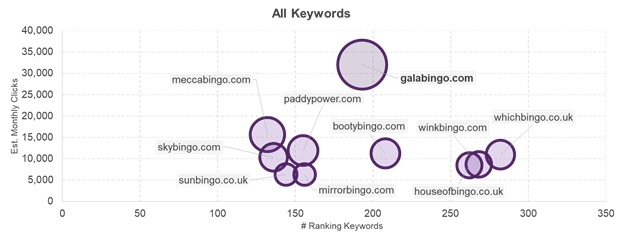
However, it isn’t a case of universally strong rankings for either brand, perhaps reflecting the competitive nature of the market and specific strategies to focus on rankings for key generics. Gala Bingo has just 33 top five rankings across our keyword set, and our analysis estimates that 94.6% of the brand’s organic traffic is coming from just four keywords.
For Mecca, it’s a similar story. The brand has just 17 top five rankings, including a position two for “bingo”, and our analysis suggests that 87% of the brand’s organic non-brand traffic could be coming from that one keyword alone. Both brands have a below-average spread of rankings across the keyword set (Mecca Bingo ranking for less than half of the keywords).
Foxy Bingo a big faller
When we performed this same analysis back in April 2016, it was Foxy Bingo that was leading the pack – marginally ahead of Booty Bingo and notably ahead of the rest of the competition.
Foxy Bingo’s visibility at the time was largely based on strong rankings for the core generic keyword terms, and the brand’s SEO approach seemed to focus particularly on the high-volume terms. Foxy ranked for just 60% of the 319 keywords that we analysed, whereas Booty Bingo ranked for 78% of keywords.
Fast forward to October 2017, and we see that Foxy Bingo has fallen significantly in our analysis. This drop is primarily driven by a fall from position one to position 25 for the term “bingo”, as well as lost rankings for a number of “free bingo” terms.
Booty Bingo has also seen falling rankings for the term “bingo” (dropping from second to 12th), and “online bingo” (third to 14th) but it has generally retained rankings across other keywords to off-set some of those losses and remain among the 10 most visible brands – albeit with lower organic non-brand traffic than April 2016.
Big brands absent in the free bingo market
When we analysed this market in April 2016, we noted that a number of the most visible brands were ranking particularly well for keywords relating to “free” bingo. Brands such as Foxy Bingo, Cheeky Bingo and Costa Bingo were all seeing page one rankings for free bingo terms.
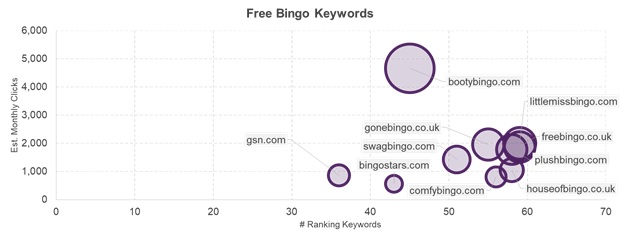
But in October 2017, we see something of a change, with only two of our top 10 most visible brands overall, Booty Bingo and House of Bingo, ranking among the top 10 for free bingo keywords.
While the volumes are relatively low, we estimate that Foxy Bingo has lost just under a third of its traffic from “free” terms.
Part of this is due to improvements in how Google uses relevancy as part of its algorithm. Previously, it was possible for brands to rank for “free bingo” terms without offering a free gaming proposition – usually instead using landing pages to promote a bonus offer. It is also possible that brands have moved away from targeting such traffic, wise to the impact that so-called “bonus hunters” may be having on their average lifetime value.