
Data: Balancing volume and engagement for betting brands
Digital marketing agency Stickyeyes looks at which sportsbooks are leading the way on social media


Social media is a key battleground in the world of sports betting, with brands investing heavily in celebrity partnerships and branded content that is designed to fuel their social media platforms and engage with both their existing customers and new audiences.
But in such a crowded marketplace, getting the right balance between the volume of content and the value of that content is a difficult task, and there are signs that a number of key brands have work to do in order to tip the scales to make the most from their investment in content. For some brands, it is a case of putting out a large volume of content that isn’t making traction in the market. For others, it is a case of producing content that resonates, just not quite enough of it.
Increasingly social brands
Of all the product areas within the egaming sector, sportsbook lends itself most naturally to social media. The fast-paced nature of sport creates a wealth of stories on an almost minute-by-minute basis, and many brands have made a conscious decision to try and capitalise on this.
Sport is very much something of a lifestyle pastime, and sports betting brands have tried to capitalise on this in various ways. Some brands, Paddy Power in particular, have developed a distinct brand voice that has allowed them to put social at the very heart of their wider marketing strategy. Other brands have tried to shy away from the “Lad’s Bibleesque” approach, with BetVictor making a particular reference to that approach in some of its advertising messages.
When it comes to the volume of activity across social media, it perhaps comes as no surprise to find Paddy Power leading the way of the 10 brands that we analysed.
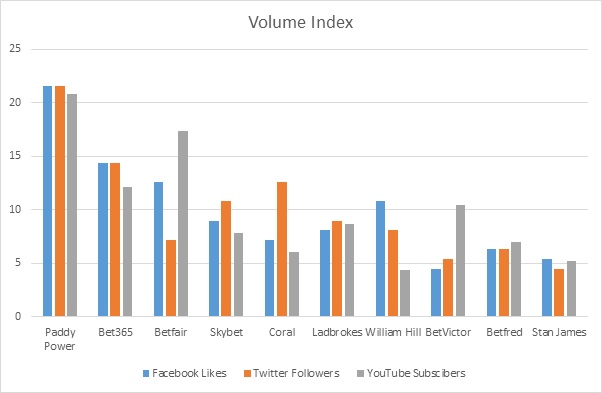
Paddy Power is the leading brand across key metrics across Twitter, Facebook and YouTube, well ahead of the competition in that regard. Bet365 has the second-highest volume, followed by Betfair, which is held back by a lower volume on Twitter. Sky Bet and Coral round off the top five.
But volume is only half of the story. Large volumes of content failing to engage isn’t going to justify its investment, so we need to look at how that content is being engaged with – and this is where we see that balance start to tip.
More is less, or less is more?
Paddy Power’s effectiveness when it comes to social media is well documented, and it is no surprise to see that they also lead our engagement index despite a surprisingly low engagement rate on Facebook. However, it is further down the index where there are perhaps some more telling insights into how different brands are approaching social media.
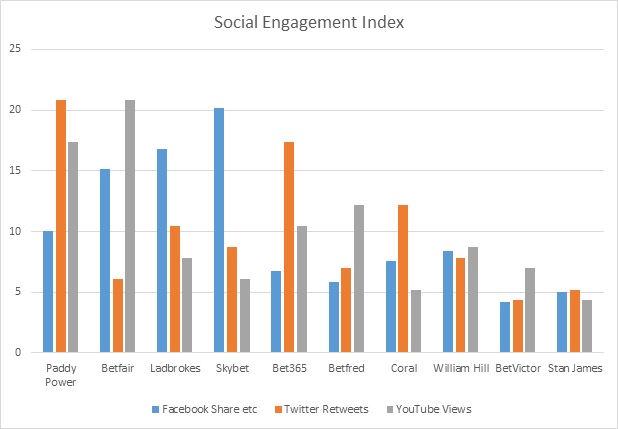
Bet365 is a prime example. This is a brand that was second on our index in terms of volume, but is only the fifth most-effective at engaging the audiences that it speaks to, largely due to its performance on Facebook. While it would be easy to suggest that the brand’s content may be the root cause of this, the strong engagement on other platforms suggests that it could be that the brand’s approach to distributing content on Facebook, given how heavily the platform’s algorithms restrict the organic distribution of content, may be a bigger factor.
At the other end of the scale, we see that Ladbrokes is succeeding in producing and distributing content that engages, despite being relatively low down the index when it comes to volume. This engagement is largely driven by Facebook, where Ladbrokes is the second-most engaged sports betting brand behind Sky Bet (which itself has only the fifth-highest Facebook volume).
This suggests that these brands have stumbled upon a winning formula when it comes to the content that they produce and the ways in which they distribute that content. So the question that follows is what they can do to capitalise on that audience and increase the volume that they produce, without negatively impacting the quality of engagement.