
Analysts fret over geographic concentration at Paddy Power Betfair and William Hill
As Breon Corcoran announces his departure from Paddy Power Betfair, the analysts pick over the numbers from the company’s first-half results, while William Hill sees something of an online revival


Words by Scott Longley
Away from the headlines of Breon Corcoran’s sudden announcement that he would be leaving the post of chief executive at Paddy Power Betfair later this year, the analysts were somewhat underwhelmed by the company’s first-half results performance.
The figures were “broadly in-line” with expectations; first-half EBITDA came in at £220m, up 21% on the year, helped by a 9% rise in total revenues to £827m and with continued strong free cash flow of £172m. So, despite Corcoran’s imminent departure stage left (pursing opportunities outside of the gambling sector), why the collective long face on the part of the analysts?
It is partly down to the underlying performance of the online gaming arm of the business that is giving investors pause for thought about the company’s ambitions. Gaming revenue was down 3% year-on-year, a marked deterioration on the number from the first-quarter trading statement when revenues were up 2%.
This is particularly lacklustre given some of the buoyant gaming trading figures being reported elsewhere. Jackpotjoy’s own brand revenues rose 16% in the six months to June while the firm’s Vera&John brand was up 21%; Ladbrokes Coral’s brief late July trading statement said gaming revenue was up 11% year-on-year; and even William Hill in recovery mode managed a 10% rise in online gaming net revenue.
In talking to analysts on the results conference call, Corcoran was honest, to the point of being brutal, about identifying what he felt were the issues facing the business and where it was falling down.
The gaming issue
“Gaming is the problem child,” he said. “We’ve looked hard at acquisitions, partnerships and launching new brands [but] our customer-facing product is not good enough. The UI is a bit sloppy. Our mobile stuff in particular is a bit dated. The gaming customer is quite demanding and by their nature they are more fickle. They are exposed to better product because of their churn.”
He added that the company felt that player management capability was better elsewhere, noting the better gaming operators “think about constantly rolling promotions, all of which is automated”. He added that testing had already commenced on a gaming-led brand that will be in the offing in the near future.
None of this particularly impressed the analysts, however. Richard Stuber at Numis noted that Paddy Power Betfair was underperforming its peers and added that competition across the online space “remains high”.
Meanwhile, the team at Morgan Stanley said that there was “no sign of recovery” in gaming and added that the commentary from the company suggested the business will remain below market growth rates throughout the rest of this year.
For all Corcoran’s lengthy mea culpa, there is a degree of expectations management taking place here. The company is under pressure somewhat to deliver on what was seen by many analysts as the promise of the merger – building scale in order to dominate markets across Europe and further afield, particularly in Australia where Sportsbet continues to go from strength-to-strength despite the various regulatory headwinds.
For many of the analysts Corcoran is leaving the job with the task of completing the integration of the two businesses half-finished and – to an extent – with questions now being posed in some quarters over elements of the rationale of the merger. This was perhaps reflected by the 5% fall in the share price on the announcement of his departure which added to the less-than-impressive share price performance in the year to date (see chart).
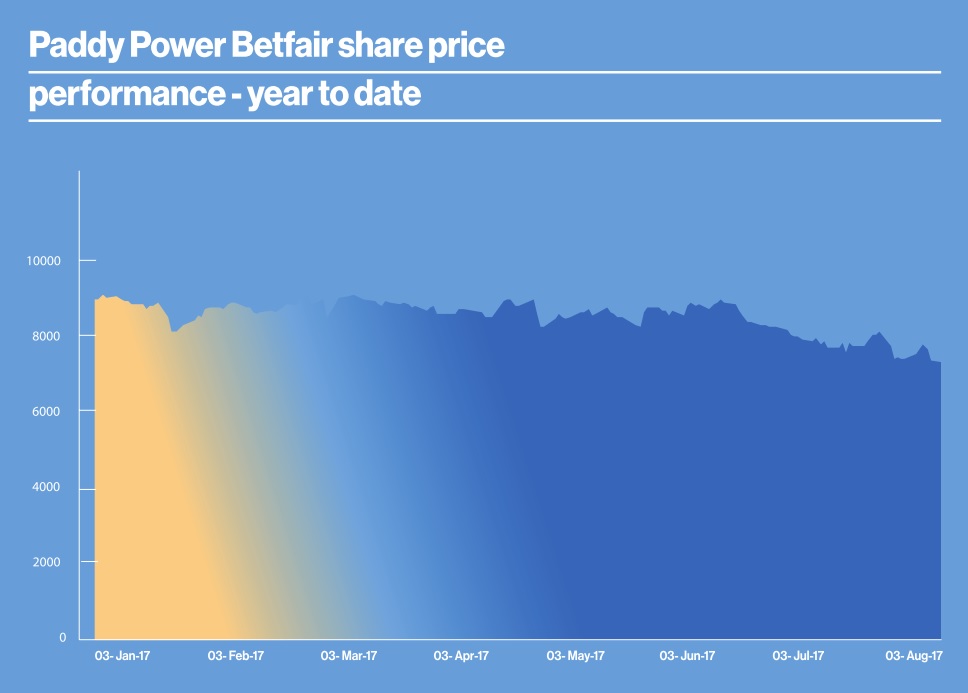
Source: Google Finance
“We were surprised by Mr Corcoran’s departure as he has been pivotal in the company’s and merger’s success, and the systems integration is not yet complete, however the press release indicated this was for personal reasons, and he will remain until the merger (and presumably the major platform migration) is complete,” said the Morgan Stanley analysts. “We think the combination of slower growth and chief executive succession will mean momentum stays negative,” said Stuber at Numis.
A somewhat rosier picture was drawn by Paul Leyland, analyst and partner at gambling consultancy Regulus Partners. “The group has the scale, talent, brand-spread and technology capability to turn this around and start winning market share again rather than losing it,” he wrote. “In an unexpected turn of events, that job will fall to a new chief executive.”
The take on grey
Going by some of the questioning on the conference call, in a few quarters there are hopes that the new chief executive will reverse policy with regard to grey markets – the online gambling industry version of being advised to loosen the tie a little.
But the possibility that the new man Peter Jackson, previously UK chief executive at Worldpay, will majorly reverse the stated Paddy Power Betfair policy of concentrating on regulated markets look slim.
Currently unregulated territories represent 5% of total revenues, and although the unregulated element rose quicker in the first six months of the year at 11% versus a 1% fall in online regulated revenues, Corcoran set out the straightjacket for his successor in his comments.
“We pride ourselves on being long-term thinkers,” he told the analysts. “We are thoughtful about investment from a regulatory point of view.”
Citing the example of Australian chief executive Cormac Barry’s view that credit betting didn’t have a long-term future in the country, he said the efficacy of avoiding the regulatory traps as laid out in various jurisdictions had a long-term benefit.
“We tolerate some grey market revenue but we have shied away from a concentration risk there,” Corcoran said. “It all depends on your time horizons.”
One such area of worry, he suggested, came with what Corcoran said “the faster-growing guys” were doing in relation to promoting gaming via the affiliate channel. “In other markets, affiliates are licensed,” he said. “There are some regulatory things we are just not comfortable with. We think the right thing to do is stay on the right side of the fence.”
However, the analysts remain unconvinced by such a strictly regulatory-abiding path. Ahead of the results, Alistair Ross at Investec suggested that that “diversification warrants a premium over geographic concentration”.
This is analyst code for wanting more grey market exposure and Ross went on to state his case plainly, suggesting the worries regarding what happens to revenues when a company gets caught out by a previously grey market moving to a regulated model are overstated.
“Empirical evidence shows that unregulated markets are unlikely to shut down overnight,” he wrote in a note to clients downgrading Betfair to a sell in late July. “Governments earn tax revenue from regulated markets, which makes it more likely for an unregulated market to become regulated, rather than illegal.
“We believe the market is beginning to take this into account in sub-sector valuations, which is leading to compression between unregulated and regulated valuation multiples.”
In this last point, Ross is referring to GVC which he says is trading at a discount to the sector average despite being more diversified and owning its own sports betting technology platform. In comparison, at least in late July, Paddy Power was trading at a premium to the rest of the sector with an enterprise value to EBITDA multiple of 11.4 times, circa 40% ahead of the rest of the sector.
This includes sector laggard William Hill which also released its first half-results in early August. The company has seen its share price struggle to date this year, largely weighed down by fears over the potential impact of the upcoming – and now severely delayed – UK governmental triennial review on maximum stakes and prizes on gaming machines in UK betting shops.
Robust performance
Also playing into the disappointing share price performance, though, is an online arm which has been struggling to live up to its previous market-leading reputation. The company will be pleased with the reaction from much of the analyst community where the word “robust” appears on numerous occasions in the post-results overviews.
As Stuber at Numis pointed out: “In its challenged online business, amounts wagered and net gaming revenue rose double-digit.”
“Governments earn tax revenue from regulated markets, which makes it more likely for an unregulated market to become regulated, rather than illegal” – Alistair Ross, Investec
Yet, as Ivor Jones at Peel Hunt pointed out, while the interims “seem(ed) like progress”, overall earnings before interest, tax and amortisation was down 1% to £130m.
As mentioned, the online gaming performance for the six months to June was impressive enough, up 10%, a figure which represented progress on the mid-period trading statement when gaming was up 7%. Such was noted by Gavin Kelleher, analyst at Goodbody in Dublin, who said the gaming performance was “all the more impressive” and “implies an acceleration to strong double-digits in the end of the first-half period.”
The green shoots were such that the company even received praise (of a sort) from ex-chief executive Ralph Topping on social media, where he has often taken to the airwaves to lambast the company for its perceived weaknesses. Writing on LinkedIn, Topping was moved by the publication of the results to praise online chief Crispin Nieboer for his efforts in “breathing life” into William Hill Online.
Yet, as Kelleher added, the investment case for William Hill “remains too binary for most”.
“Given the percentage exposure the group has to UK retail the main driver of the investment case remains the outcome of the triennial review into gaming machines, which is not expected until October at the earliest.”
Upping the stakes
The company’s long-term strategy – weather the worst of the triennial review and revive the online business both in Europe and Australia – received welcome backing post-results when it emerged that the investment fund Silchester International Investors had snapped up a 5% stake in the company. The investment makes Silchester one of the largest institutional investor in William Hill, although still a way behind major shareholder Parvus Asset Management with 14%.
The timing of the investment is notable. Much has been made of the triennial review overhang and certainly if machine stakes were busted down to £2 it would severely impact the company as a whole. As was noted by Leyland at Regulus Partners, machine profits are worth 120% of retail EBITDA and 80% of total group profit.
As with the complaint from Ross at Investec with regard to Paddy Power Betfair about geographic concentration, William Hill is similarly reliant on the UK and Australia for its revenues (a combined 62% in the first half of this year). With machine stakes under threat in the UK and the credit betting ban likely to do more harm to William Hill in Australia than Sportsbet, chief executive Philip Bowcock will have his work cut out for the next six months or more.
As Leyland concluded, though the company is “no longer in an operational tailspin” it is too early to identify any real strategic progress. “Further operational progress notwithstanding, the key focus for the next 12 months is likely to be dealing with regulatory-fiscal issues that form very significant threats to the fabric of both UK retail and Australia markets.”