
Has Paddy Power proven there is still life in print?
Famous for its ability to zig when others zag, Paddy Power is never afraid to push the envelope when it comes to marketing. But was producing a one-off football magazine from scratch with a print run of over a million copies worth the gamble?


Print is dead, or so we’re often reminded. While this exaggerated prophecy on print media’s future probably vexes those purists who still enjoy thumbing through inky newspapers or glossy magazines, there is no escaping the inexorable shift of eyeballs to digital channels. For many, buying physical newspapers and magazines is an outdated or alien concept, particularly when so much content is freely available online. This is reinforced by the general trend of slumping circulation figures and titles closing up shop.
Mirroring the trend of mainstream media outlets, gambling operators and affiliates have jumped on digital and social media channels with gusto by churning out an abundance of written and video content, as well as podcasts and live streams on platforms like Facebook Live and Periscope. After all, their target audience is online, right? So, when Paddy Power recently unveiled its own 48-page printed (yes, printed) football magazine to coincide with the new season, this unconventional play would have turned a few industry heads.
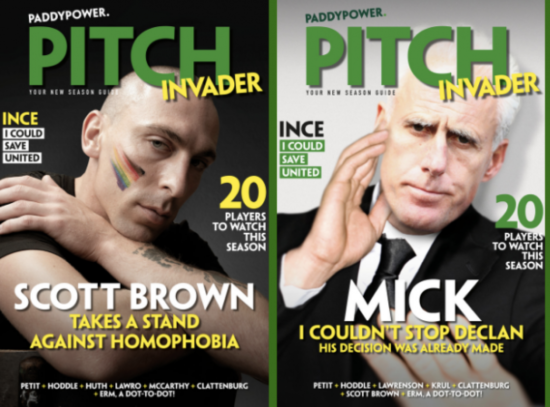
As well as being distributed in some 600 UK and Irish Paddy Power shops and over 300 pubs, the one-off and free publication, entitled Pitch Invader, was also bundled with national and regional newspapers. In fact, Pitch Invader had an impressive circulation of 1.2 million. This is slightly more than the print run of the UK’s second most popular national daily newspaper, the Daily Mail.
Hold the front page
The project was the brainchild of Lee Price, head of Paddy Power PR, one evening as he was slumped on his sofa at home watching TV while communicating online with a colleague. “It came about from where most of our ideas come from – a late-night WhatsApp conversation,” Price recalls. “I was talking to Paul Mallon, the head of major brand activations, and I just said, ‘we should start a football magazine’.”
You could say misty-eyed nostalgia for those halcyon days of football magazines and their much-anticipated season previews were Price’s main motivation. “When I was younger, I used to get every football mag during the summer. Paddy Power has done research that proves that there is an actual void in football fans’ lives outside the football season. As it comes to August, anticipation goes through the roof.” He adds: “We know that print is on the decline and a lot of companies have gone online-only, but there is something special about that printed pre-season magazine.”
After various meetings where the idea, together with the look and feel of the mag, were pitched to bosses, a budget was signed off to produce it in-house and the team was assembled. Price, who in the past spent six years as a feature writer at The Sun, was installed as editor, while Mallon, previously a 13-year veteran at the Irish Daily Star, was installed as sub-editor. Two internal staff were enlisted as writers, alongside a freelance journalist and two designers.
Big-name signings
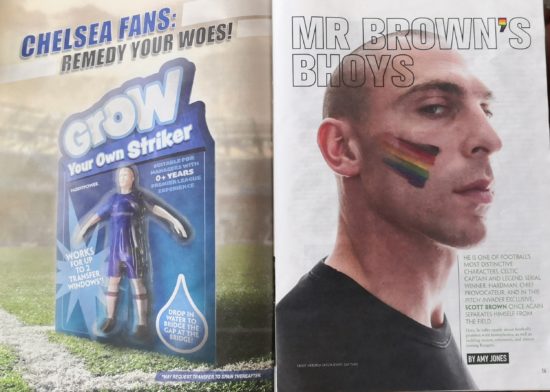
From the get-go, Mallon was “very confident” they would easily fill 48 pages, yet he was cognizant of their limitations. “As a betting company we didn’t have easy access to footballing talent the way a traditional news organisation might, and we had to stretch our contacts list pretty hard to make those exclusive interviews work.” Those interviews they ended up securing included Celtic captain Scott Brown, ex-Republic of Ireland manager Mick McCarthy, former England boss Glenn Hoddle, France’s World Cup 98 winner, Emmanuel Petit, and Norwich City goalkeeper Tim Krul.
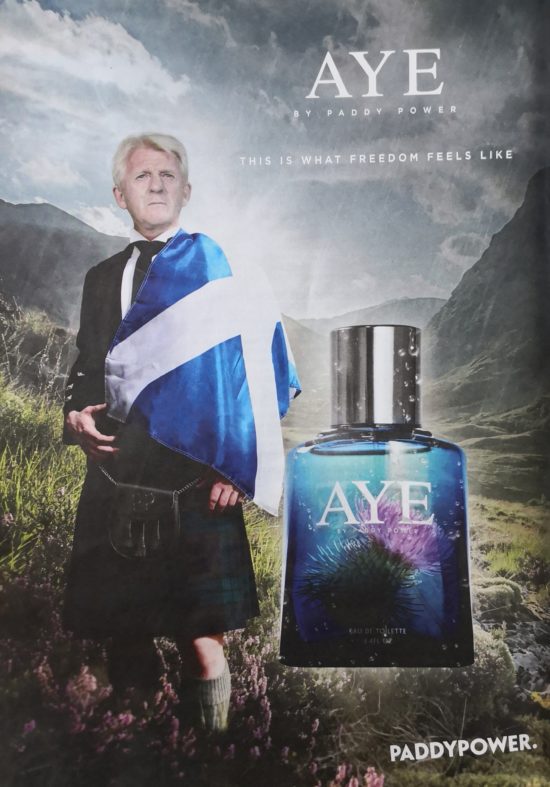
These conversations are interspersed with the type of irreverent, tongue-in-cheek content you’d expect from Paddy Power. There are even spoof ads, including one with pint-sized Paddy Power ambassador Gordon Strachan posing in a kilt with the Saltire draped over his shoulder to promote the fictitious fragrance ‘Aye’. In fact, the Scotland legend came in useful for roping in ex-players. “He liked the idea of the mag and started texting his mates and calling in favours,” Price says.
“We got really close to an interview with [Celtic manager] Neil Lennon and Gordon would have interviewed him for us. But it got blocked at the last minute because the club has a betting partner that, for fair reasons, wouldn’t have been up for him appearing in our mag.”
Ad space?
Perhaps what’s most striking about Pitch Invader is the lack of in-your-face marketing. Apart from the front cover featuring the Paddy Power logo, there are just two genuine adverts. One is a sign-up offer for the Irish bookmaker, while the other promotes the firm’s Onside app, used to track and cash out retail bets. And that’s it. There also aren’t any odds or betting-related content anywhere in the publication.
“To be honest, there were some heated conversations about this, mainly between Lee and myself,” Mallon tells EGR Marketing. “I was firmly of the belief we needed more betting content and trader insight but Lee as editor won out. And he was right. At this stage of the season, I’m not sure that loading it with betting odds would have served any real purpose for customers – they already know who’s favourite for the Premier League and so on, and it’s too early for any real long-shot value.”
If a rival betting company set out to create a magazine ahead of the new season, there is a good chance it would include betting articles and odds. It would almost certainly be far more strait-laced. Indeed, only Paddy Power’s unique tone of voice and record for mischievous marketing could pull off a mag that could be described as a cross between FourFourTwo and Viz.
PR consultant Alex Donohue, formerly of Ladbrokes, says: “Pitch Invader is right in the sweet spot for a piece of marketing communication from Paddy Power in that their brand underpins and validates the concept in such a way that would be difficult for other operators to replicate.” He also says: “As other marketing avenues are either shut down, proven to be ineffective or riddled with potential compliance infringements, opening a new channel looks like a smart and progressive move even if using a seemingly dated media format.”
Return of the mag
Although Pitch Invader was always a one-off project, there could soon be discussions internally about creating a follow-up issue for the European Championships or next season. Price, who describes the whole experience as “quite a surreal ride” and says he would love to do it all again, insists they would give themselves more room to complete the project next time. It took six weeks to produce this issue, while still working on their normal day jobs, and there were some anxious moments as the five-page Scott Brown interview came in with just days to spare.
The rise of football fanzines and dedicated indie football mags like The Blizzard, These Football Times and Eight By Eight, prove that print is still very much alive. These publications are favoured by true football connoisseurs and those fans fed up with clickbait articles and websites stuffed with intrusive ads and auto-playing videos. So, Paddy Power might indeed be onto something by swimming against the tide and backing print. Mallon, who says the reading experience on mobile “can still be shocking”, concludes: “There is still something very special about print – and that magnificent aesthetic of seeing brilliant pictures and words collide on a spread. You don’t get that online.”