The truth hurts: is the public health lobby distorting the facts around problem gambling?
While the sector waits on the UK white paper, it is clear the public health lobby only sees whatever comes out of the review as a staging post for ever more stringent – indeed prohibitionist – measures to halt all gambling activity


If anyone was left in any doubt about the extent to which the public health experts are now wedded to a prohibitionist agenda for gambling in the UK, then the Delphi study published by the Lancet in early August is instructive. The study was undertaken at the behest of Public Health England (PHE) (which was absorbed into the Office for Health Improvement and Disparities (OHID) on 1 October 2021) and sought out the opinions of 38 public health experts from around the world on a range of potential measures to reduce gambling activity. The various measures were then winnowed down to which ones the experts thought would be the most effective at reducing gambling harm. It makes for a sobering list. Working through the recommendations that the public health experts have decided will do the most to cut down on gambling harms is really a prohibitionist’s charter and would include: • a ban on all advertising of gambling including a ban on all sponsorship • an outright ban on in-play betting on sport as well as a ban on spread betting on sports events • website curfews with limits on how long a website can be in operation within a 24-hour period • a limit on the numbers of customers that can use a website at any one time • a ban on gambling on newly registered accounts for an unspecified amount of time • ban the ability to play on multiple sites at any one time • a ban on all bonuses and customer loyalty programmes • the institution of affordability and source of funds checks on customers • operators’ duties to be raised each year above the rate of inflation. It should be stressed that these aren’t measures the panel would simply like to see. These are the measures they feel would be effective in curbing problem gambling from a long list of 103 measures – “sourced from several key resources and inputs from public health stakeholders” – which the researchers who completed the study on behalf of PHE said could substantially strengthen regulatory controls while providing new resources. “The findings of our work offer a blueprint for a public health approach to preventing harms related to gambling,” the study claimed.
How did we get here?
The report suggests that calls for a public health approach to tackle harmful gambling were first made in the late 1990s. But it adds that “in the last five years it has been widely recognised that health, social and economic harms are experienced by a relatively large population of gamblers, their families, those in their social network and those in their community”. The “widely recognised” element in there needs to be examined, however. What is undoubtedly true is that the public health lobby has been pushing government for the last three or four years to see gambling as a public health issue. That is not the same as saying it is ‘widely recognised’, even if key stakeholders within the debate in the UK have increasingly come to accept the arguments about public health. Back in March 2018, Public Health England’s remit was expanded to explicitly “inform and support action on gambling-related harm” as part of the then Department for Digital, Culture, Media and Sport (DCMS) review. In May that year, the DCMS then announced that PHE would conduct an “evidence-based review” of the health aspects of gambling-related harm to “inform action on prevention and treatment”. The report was published last September and laid out what PHE believed were the total costs of gambling-related harm to the UK economy. That figure was somewhat improbably pitched at £1.27bn. Controversially, that report included estimates for the cost of suicides related to gambling, which totalled £619m, or over half the total. To come up with a monetary cost to the economy, the report estimated there were 409 suicides related to gambling in 2019. That should be understood as a made-up figure. As Dan Waugh, partner at Regulus Partners, suggests, these figures are based on “opaque calculations, highly speculative methodologies and misleading information”.Making it up
Digging into PHE’s report and the assumptions it makes, Waugh suggests there are four obvious areas which don’t stand up to scrutiny: • First, the way the calculation is made is opaque and may be mathematically incorrect. • Second, it is based on a fundamental misunderstanding about gambling disorders that suggests the researchers lacked basic knowledge about the subject they were addressing. • Third, PHE ignored clear warnings about the inappropriateness of the exercise they attempted from the very researchers whose work they used. • And lastly, in attributing all costs to gambling, PHE ignored a substantial body of research literature on psychiatric comorbidity and temporal sequencing. Waugh followed up his critique of the PHE report with Freedom of Information (FOI) requests to the Department of Health and Social Care (DHSC), with FOI’s response to date stating PHE had made a mistake in its cost estimates around suicide. The mistake relates to PHE taking data from a study of pathological gamblers in Sweden and using that data to assess the likelihood of suicide among a population of problem gamblers. The admittance is significant as it means a key plank of the PHE report – the number and cost of these suicides – simply cannot be relied upon. Moreover, a Gambling Commission (UKGC) review of the PHE report also explicitly says the section on suicides “is not particularly lengthy and is based on a single study in a different jurisdiction”.Where does the UKGC stand?
Publicly, at least, the UKGC was quick to embrace the PHE report. In the official press release, Tim Miller, executive director at the UKGC, said that it was “pleased to welcome this important independent report”. “Protecting people from gambling harms is a priority for the Gambling Commission, and we take a public health approach to do so. Public Health England’s work will help to support the continuing collaboration of a wide range of bodies under the National Strategy to Reduce Gambling Harms.” However, in an internal review document of the PHE report (obtained under an FOI request) the UKGC expresses an element of surprise about some of the conclusions of the report, notably with regard to the £1.27bn figure. The UKGC review states: “Given the (mostly acknowledged) limitations, it’s surprising that the £1.27bn cost of the gambling industry has been promoted by PHE as one of the main findings from the entire review. This may be due to its status as being one of the few conclusions that is ‘new’, a desire to emphasise the need for further research to strengthen the evidence base or intending to ensure gambling is considered as a public health issue.” The UKGC then appears to indicate disappointment that cost estimates are not at least at the level of industry duty receipts and suggests that PHE is itself aware that they are inaccurate. “However, the lack of data and underestimated costs means that the estimated costs in this review are significantly below even the tax receipts from the gambling sector in 2017, which were estimated to be £2.7bn. “The report succeeds in highlighting that there are costs to gambling, but I don’t believe that even PHE have confidence that £1.27bn is an accurate estimate of those costs.” As Waugh suggests, an elision takes place within the UKGC review. The PHE report referred to “costs associated with” [emphasis added] gambling, at-risk gambling and problem gambling, whereas the UKGC review states the “cost of the gambling industry”, which is to infer causality. Moreover, the approach of attributing costs of the gambling industry also deliberately excludes potential economic benefits.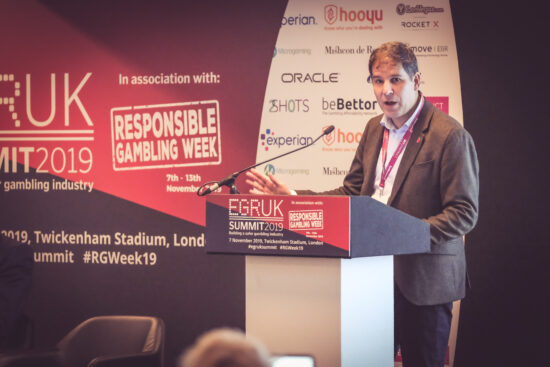
Dan Waugh, Regulus Partners