
Stronger together: how GAMSTOP has teamed up with RG partners to protect at-risk players
GAMSTOP continues to raise awareness as self-exclusion registrations rise, however a three-pronged approach to player protection provides the best recipe for success


The UK’s national self-exclusion scheme, GAMSTOP, reported record registrations in February as overall sign-ups surpassed the 200,000 mark for the very first time. GAMSTOP went live in April 2018 and then became a licensing condition for UK-licensed operators from March 2020. On 22 February 2021, 326 registrations were recorded, the highest daily figure since its creation. Since then, GAMSTOP CEO Fiona Palmer has said the scheme remains on a “steady trajectory” and is witnessing 220 new sign-ups per day on average. So, what is behind the rise? The most obvious answer is a general upturn in online gambling participation brought about by the Covid-19 pandemic. There are several drivers of this, including people seeking digital entertainment online while not being allowed out, and a migration of retail gamblers online while betting shops and land-based casinos were forced to close. Further proof of a rise in online gambling participation was reflected in the financial results of the UK’s leading operators and affiliates, the vast majority of which have posted double-digit digital growth in back-to-back quarters. But has this rise in participation also led to an upturn in gambling-related harm? Nobody is sure. “We don’t know for certain because we don’t ask people why they’re registering,” says Palmer. “The most important thing is that they take that step if they want to.” Meanwhile, Matt Zarb-Cousin of Clean Up Gambling adds: “Online gambling has picked up the slack and some of the more addictive products have increased quite significantly like slots.” Zarb-Cousin runs the not-for-profit campaign managed by AMZC and is also director of external affairs at Gamban. He says: “It’s difficult to make empirical inferences from that, but I think what’s clear is that there is definitely more awareness of the help and support currently available.” GAMSTOP has been seeking to raise awareness of self-exclusion among the UK’s at-risk gambling community and its increased profile is the main driver for the rise in registrations, according to Palmer, who thinks much of it comes down to people using the service and then speaking more openly and freely about their experiences. Stacey Goodwin for example, who at her lowest point lost £50,000 in six days and attempted to take her own life, is now using social media to help raise awareness, particularly among the female gambling community as she feels women suffer in silence. Goodwin, who started working in a betting shop at 18 and is now 28, has set up a TikTok account called The Girl Gambler. “We are keeping an eye on social media where Stacey has started and she’s got a fantastic TikTok channel,” says Palmer. “It is about reaching out to new areas and new audiences and raising awareness while trying to help remove the stigma associated with issues around gambling.” Another vocal proponent of self-exclusion is Matt Blanks, a project manager at Peer Aid, which helps people addicted to gambling. He is active on Twitter and has previously said of self-exclusion: “It gives you that moment’s pause, that bit of breathing space, to ensure that when you have an urge or impulse, you can’t place a bet in that moment. That time to reflect can make all the difference.”
A layered approach
While self-exclusion is proving an increasingly popular and effective tool available to those dealing with gambling addiction, it is by no means a silver bullet, and a multi-faceted strategy works best in so far as understanding and combatting harmful behaviours. This is why the TalkBanStop pilot was born in the UK. TalkBanStop combines GAMSTOP with gambling blocking software tool Gamban and GamCare, which powers the UK’s National Gambling Helpline. The one-year pilot, which began in December 2020, is being evaluated by Ipsos Mori and has so far been embraced by leading UK-licensed operators including Kindred Group. Effectively, it’s a three-way partnership that combines practical tools with support to help anybody who wants to stop or reduce their online gambling activity. “We have what is called a ‘no wrong door’ policy,” GAMSTOP’s Palmer tells EGR. “Anybody who comes to us will be signposted to the National Gambling Helpline, where they will also be offered free licences for Gamban to download blocking software onto their devices. There is also an opportunity to make people aware that they can block financial transactions through their banks.”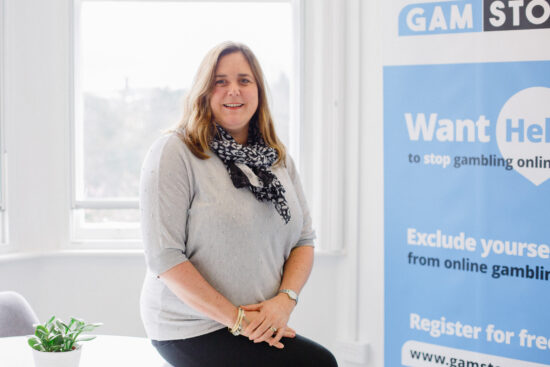
Fiona Palmer, GAMSTOP