
William Hill's Ulrik Bengtsson: "We are coming out of Covid-19 stronger than we came into it"
With sports resuming and turnover picking up after lockdown, William Hill's CEO discusses the impact of coronavirus on the business, the upcoming review of the Gambling Act, and how winning on product will restore the operator’s digital fortunes


“A year of transition for William Hill not without challenges”, was how Ulrik Bengtsson summed up 2019 when he addressed investors and analysts at the FTSE-250 company’s full-year results presentation back in February. The entire year, he stated, was overshadowed by the fallout from the slashing of maximum stakes on FOBTs to £2 and the business having to close more than 700 shops. Yet that all now pales into insignificance to the first half of 2020 with a global pandemic forcing the closure of William Hill’s entire retail arm in March and staff having to be furloughed, with the UK government paying 80% of salaries up to £2,500 and the operator topping up the remaining 20%.
Furthermore, the sporting calendar was obliterated for weeks on end, apart from the likes of Russian table tennis and a handful of obscure football leagues in far-flung parts, leaving online customers with an underwhelming menu of action. In a trading update the operator announced group revenue slumped 50% in the six weeks to 8 June, which was a slight improvement on the 57% fall for the six weeks prior. US revenue was down as much as 90% at one point with retail sportsbooks shut. It would probably be fair to say coronavirus has been the most challenging period the bookmaker has endured in its existence since William Hill founded his eponymous business as a telephone and postal betting service in 1934.
However, football and horseracing (80% of its UK online sportsbook business) have begun to make a welcome return behind closed doors, and William Hill has reopened its retail estate, albeit with social distancing protocols. The firm’s share price has rebounded 300% since plunging to just 29p at one point in March, while £224m was raised last month in a discounted share placing equivalent to 19.99% of its overall share capital. This will strengthen the balance sheet and fund expansion in the US. Combine this with a VAT refund from HMRC due in H2, which is roughly equivalent to the outstanding £203m paid on its 2020 bond, as well as unrestricted liquidity of more than £500m, and Peel Hunt analyst Ivor Hunt said Hills could now invest in opportunities “without always having one eye on the bank balance”.
Speaking to EGR Intel from his home in London, CEO Ulrik Bengtsson says: “Looking back to the end of March, everyone was a bit rattled and it was hard to have visibility on what was going to happen. We decided to act quickly and decisively, without necessarily having all the information, and made sure we retained as much cash as possible in the company. We suspended the dividend and we made significant cost savings around teams, staff and salaries, and marketing and supplier management.” Indeed, all company-wide salary increases and bonus payments were cancelled, while Bengtsson, who earns £600,000 a year, would forgo bonuses and long-term incentives.
As coronavirus began to take hold in March, management anticipated the impact leading to a cash-burn of up to £30m per month. Yet, by May, cost controls had halved that amount and now, Bengtsson reveals, the business has managed to suppress the burn to £10m or less a month. “We really made significant changes to the cost structure of the business, and that will continue as that never ends,” he adds. “As sports start to come back, we come out of this with a slightly better cost structure. I truly believe we are coming out of Covid-19 better than we came into it. We are a stronger company from a cost perspective, teams have been gelling and we have a much stronger balance sheet given our [share] placing the other day.”

Ulrik Bengtsson (Source: William Hill)
An inside job
Bengtsson assumed the role of chief executive last September, replacing Philip Bowcock who stepped down after more than three years in the post. Like with Bowcock, who was previously William Hill’s CFO, the board chose again to promote from within for the top job. Bengtsson had been the company’s chief digital officer for 18 months after arriving from Betsson Group where he’d served as CEO for five years, increasing annual revenue from SEK2.2bn to SEK4.7bn and EBIT by 50%. He also managed the acquisition and integration of eight companies. Upon the unveiling of his appointment as Hills’ new boss, the board singled out Bengtsson’s international and industry experience and, crucially, his “deep understanding” of the digital side of the business as William Hill looked to realise its online ambitions.
Reflecting on his first nine months in the role and the advantages of already being employed in a senior role within the operator before taking up the reins, the 48-year-old Swede says: “Needless to say, it’s been nothing like what I expected when I took over and we have had to deal with the consequences of the Covid-19 situation. All in all, though, I was quite prepared; I’d done 18 months in the company and it wasn’t too hard to find my feet. I was hugely honoured as William Hill is one of the finest companies in our industry and we have a huge amount of potential lying ahead of us.”
He continues: “William Hill is a complicated company because of our size, but also because of the diversity of the business with retail, online and international, including the US. They all have different challenges and ins and outs, so I think it really helps coming from the inside. Having spent 18 months as chief digital officer, that helps me shortcut in getting to the solutions to some of our challenges. I was pretty well-prepared coming into this and I had a very clear view of what we needed to address.”
Sep 2019: Group CEO, William Hill
Apr 2018: Chief digital officer, William Hill
Jul 2012: CEO, Betsson Group
Jan 2008: CEO, pay-TV and emerging markets, Modern Times Group
Aug 2004: CEO, Viasat Broadcasting in Sweden
Jun 2001: Sales director, Telenor
Jan 2000: Sales director and co-founder, CtrlPrint
Jun 1996: Various roles at IBM
Education: A B.Com from Dalhousie University in Canada where he played varsity ice-hockey
High on his agenda was a renewed focus on delivering on product. Indeed, Bengtsson is a product guy through and through, who firmly believes there are very few successful companies bereft of a stellar product. Just look at the likes of Netflix, Amazon, Uber, Spotify and Apple. To help with this push, Satty Bhens was hired from McKinsey & Company as global chief product and technology officer, tasked with ensuring the platform and engineering capabilities go hand-in-hand with product ambitions. And just recently, The Stars Group’s former head of engineering, Nedda Kaltcheva, was recruited as chief technology and product officer for William Hill’s international arm.
For Bengtsson, these appointments form part of the “relentless focus” within the company on three key pillars: customer, teams and execution. The first is about putting the customer front and centre and excelling on product, while the second revolves around building agile and collaborative teams. The final pillar – execution – was previously the “Achilles heel for a long time”, Bengtsson reveals with a slight audible sigh. “To do what we say we are going to do and really get on with execution and delivery. In the last six months, we have had a real nice track record of delivering [on product], particularly towards the customer.”
These projects include a new sportsbook front-end in Italy and Spain, single-wallet functionality in Spain, an overhauled casino product in the UK, as well as a slew of product deliveries in the US (more on that later). “We have been able to point to a string of really strong and large structural deliveries, with numbers coming on the back of that as you would have seen in the trading update both in our international business, which has grown consistently throughout Covid, and UK Online is showing great momentum. So, we’re very pleased with that.”
Bengtsson insists William Hill is emerging from coronavirus-induced lockdown “better than we came into it”
Regulatory headwinds
Even before Bengtsson landed the top job, he was fully aware of the scrutiny the UK industry’s major operators were under from politicians and the mainstream media, particularly because of previous shortcomings around responsible gambling (RG).
Although many firms have made great strides in the past couple of years when it comes to mitigating gambling-related harm, including William Hill’s ‘Nobody Harmed’ initiative, the sector still finds itself very much under siege. And now a cross-party group of MPs are calling for a blanket ban on gambling marketing, a £2 limit on online slots and even an end to in-play betting online. Furthermore, a damning House of Lords report into the industry has made 66 recommendations, including an end to gambling sponsorship in sport and bet-to-view live streaming. So, does the industry only have itself to blame for all this unwanted attention?
Bengtsson responds: “I think it’s fair to say that the industry historically has not always done everything it could, but you also need to recognise that when the Gambling Act was put together in 2005 no one knew how this was going to develop, what direction it was going to take, and no one knew what technology was going to be available for things like age verification.
“We also have learned a lot and we’ve moved with the times. Have we always moved fast enough? Maybe not. We can always move faster, but I think you also need to recognise that 2005 was a very different world and it was hard to predict how things were going to evolve.”
The UK government will be conducting a review of the Gambling Act, although no timetable has been published. Bengtsson insists William Hill welcomes the review, yet he is unequivocal in how the probe should be conducted. “We want to see a fact-based, evidence-based, data-driven review of the Act,” he asserts.
“I think that’s the only way to put the conversation to bed. Whether you are an operator, a politician, a newspaper or an interest group, you need to get behind the review of the Act and take it as an opportunity to give input. Once it [the review] is published, we all stand behind it and we all support it. That’s the only way to get a unified front on the topic and get away from this divide.”
The legislation, which came into force in September 2007, laid the foundations for the most successful regulated online gambling market in the world with channelisation estimated to be as high as 98%. However, Bengtsson cautions: “We need to be careful not to destroy that success.” He follows up by highlighting his native Sweden, a market where William Hill launched in 2019 alongside its Mr Green brand, as an example of disappointing channelisation. The temporary deposit limit of SEK5,000 (£430) and bonus cap of SEK100 (£8.60) from 2 July has further frustrated licensed operators.
“Sweden [is] most notably now below [a channelisation rate of] 80%, maybe down to 70%, which is a complete failure,” Bengtsson stresses. He also warns of the dangers posed by the black market to the UK’s £5.5bn regulated remote sector by over-regulation driving players to seek out unlicensed betting and casino sites. “We have seen a surge in the search volumes for non-UK casinos during Covid – a massive increase on Google,” he states.
“These sites allow UK players to register, they take British pounds and have no age verification. The danger is once you start to restrict advertising and product features, it actually has the reverse effect on player protection. You will see more problem gambling, but it will be hidden. This is evidenced in many countries, so it isn’t something I’m making up. It’s a fact of life.”
There is no getting away from the fact that increased UK regulation has already hit William Hill, and rival companies, in the pocket. The drastic FOBT stake cuts contributed to William Hill’s operating profit slumping 37% to £147m in 2019, although this was ahead of management’s expectations. Meanwhile, the 40% increase in remote gaming duty from 15% to 21% of GGR cost the business £13m last year. Enhanced customer due diligence was another £12m. When you factor in the recent credit card ban, a reduction on the reliance upon VIPs (these players account for 0.6% of Hills’ customer base yet 20% of revenue), and now the threat of ad bans and online stake limits and you start to wonder how much tougher the UK market can get.
“There’s no doubt the UK is possibly one of the most competitive markets in the world, and it’s very challenging to operate here.” Bengtsson adds: “We’re in a flat market that is being increasingly regulated, with some large players in it, [so] that’s a really tough market. But I’m a believer in scale and brand and we have the highest awareness of any brand in the UK in terms of gambling. Scale is important and, although we might not be as big as some of our colleagues, we are still one of the absolute dominant players in this market and that will help us going forward.”
International player
William Hill is increasingly spreading its wings overseas as it strives to become, as management have been at pains to stress, “a digitally-led, internationally diverse gambling company of scale”. Last year, for example, 24% of overall revenue was derived from outside the UK, up from 15% a year earlier. With online alone, 35% of revenue was accrued from outside the UK compared with 24% in 2018. The £242m acquisition of casino-centric online operator Mr Green, which launched in Spain recently, has assisted with diversifying and boosting revenue streams. As has the US. William Hill threw its hat into the ring across the pond back in 2012 by snapping up three Nevada bookmaking chains for around $50m. This was six years before PASPA was overturned by the US Supreme Court in a landmark ruling.
Today, with seasoned bookie Joe Asher at the helm, William Hill US is present in nine states – Delaware, Indiana, Iowa, Mississippi, Nevada, New Mexico, New Jersey, Rhode Island and West Virginia – through a mixture of B2C and B2B set-ups. Nevada is still by far its largest market, with $1.64bn in betting handle (69% on mobile) last year and over 100 retail locations, giving William Hill a 32% market share.
Yet the operator has its eyes set on expansion thanks largely to the market-access deal with Eldorado Resorts in which the casino group took a 20% stake in William Hill US. Eldorado’s $17.3bn merger with Caesars means Hills now has routes into two dozen states and a potentially addressable population of 200 million. “If you don’t have access to a state, you can’t play,” Bengtsson stresses. “It’s as simple as that. We have market-leading access in 24 states.”
Arguably, the firm’s most important recent product development has been what Bengtsson calls “state-in-a-box”, enabling the rapid deployment of sports betting in live states. “That allows us to roll out a new state in virtually any type of regulation with any type of [customer] registration process within six weeks. That’s going to go live this summer in Indiana and we’re going to roll that out as an umbrella technology for the rest of the states that go live.”
Another ace up its sleeve stateside is the deal struck with TV and online network CBS Sports, which boasts 80 million users per month and one of the world’s largest fantasy sports platforms. The arrangement allows William Hill to exclusively integrate its odds, content and branding into CBS shows and websites, as well as gain access to that huge fantasy sports user database for marketing and customer acquisition purposes.
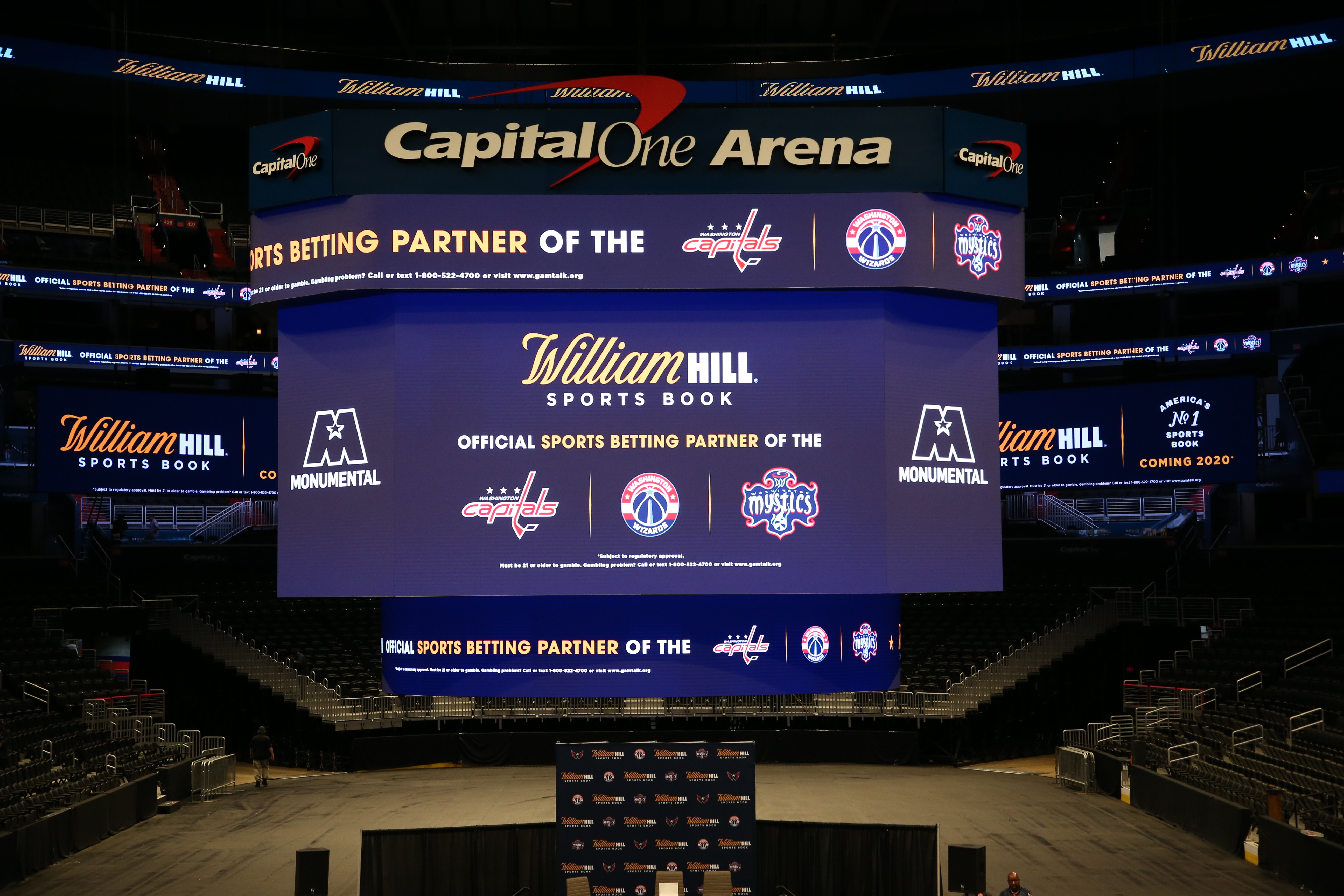
With market access secured in 24 states, William Hill is pinning its hopes on the US driving future growth
The downtime of late with precious little sport taking place has been partly used for the integration between the two brands ahead of the launch to coincide with the upcoming NFL season. In fact, to borrow a blackjack term, Bengtsson says William Hill has “doubled down” during lockdown on “big deliverables”. One key project, which he freely admits should have come sooner, has been the launch of online casino for the William Hill app in New Jersey, home to the company’s digital hub. The product is awaiting regulatory approval and is slated to go live in the next few months in a state with 20-plus online casino brands serving a population of under nine million.
“We’re going to roll that out in the states that allow egaming; most likely New Jersey is first followed by Michigan,” Bengtsson reveals. William Hill signed a market access deal in February with tribal-owned Grand Traverse Resort & Casinos. Currently, six states have legalised egaming, with Michigan and West Virginia to launch soon, while on the sports betting front there are 18 states and Washington DC currently live, another four where laws have passed, and 16 with active legislation.
Indeed, Bengtsson expresses surprise at the “incredible speed” at which states have legalised sports betting and the “sheer size” of the market, albeit fragmented, in terms of opportunities. “Demand is clearly there – this is going to be a very large market. We say $8bn but there are plenty of other assessments. No matter how you look at it, it’s going to be large.”
Yet if New Jersey’s online sports betting market is anything to go by, William Hill and other well-known names could have their work cut out on the B2C front at least. According to US research firm Eilers & Krejcik Gaming, William Hill held an 8% share (third spot) of the market in the 12 months to April 2020. The runaway leaders were DraftKings and Flutter-owned FanDuel with a combined market share of 74%, and this former DFS-only duo are already formidable forces in the states where they are live. Hills, though, is confident its experience in the US, combined with market access in nearly half of all states, the CBS tie-up, and a proprietary platform and tech stack are key foundations to build on hitherto progress.
In fact, Bengtsson is quick to point out the fact that William Hill US has racked up seven consecutive years of strong growth and a CAGR of 35% on wagering since 2012. Last year, the business added more than $1bn in wagers, of which 60% were via mobile.
“That gives us a 25% national market share, so effectively one in every four bets in the US is taken by William Hill. That is an incredibly strong position to start this accelerated growth phase ahead of us.” He adds: “That makes us America’s number one sportsbook, effectively. But that’s not so important; the important thing is what’s ahead of us and how we continue to capitalise on the opportunity.”
So is the US arm, where revenue was up 30% prior to coronavirus-induced lockdowns, the group’s most important asset right now considering the headwinds in regulated European markets, including the UK? “In terms of opportunity for future growth, I don’t think we have anything that can compare to the US,” Bengtsson acknowledges. “But in terms of stable profit and cash coming in, UK Online is still a very good business despite all the challenges we are facing. Our guys in the UK are doing a phenomenal job in a very tough environment and it is an inch-by-inch game, much different than the US where you move big pieces. That requires a certain level of tenacity and relentlessness, which I really appreciate.”
To ensure a strong recovery in 2021, William Hill recently announced the merging of its UK retail and online divisions from September, with retail MD Nicola Frampton departing the firm.
Combining forces
Just as the interview is coming to an end, the subject of M&A is broached seeing as consolidation continues to dominate the sector. With acquisition-hungry Flutter and GVC now multi-brand giants of the space fuelling market caps of £17bn and £4.3bn respectively, is now finally the time William Hill (£1.25bn) got involved in a significant combination after flirting with deals in the past? Moreover, does William Hill need to get into bed with another company, or more than one company, to achieve the necessary scale and firepower to compete?
Understandably, Bengtsson is coy when it comes to any potential M&A involving his business, instead deflecting the question by saying William Hill is “playing the cards we’ve been dealt and building a digitally-led business of scale”. “Consolidation comes and goes in waves. We are not embarking on any acquisition sprees [but] we are always opportunistic. If something comes around for one reason or another that looks advantageous to us, we will of course look at it. But it’s not at the heart of our strategy.”
As we enter the second half of a truly unprecedented and incredibly challenging year, even at this stage, how does he think 2020 will be summarised at Hills’ next full-year results presentation in 2021? A pronounced pause follows as Bengtsson composes his thoughts. “As a society, it will be a year that we all just want to put behind us and move on. But what I’ve seen of the company in the last three months has said a lot about William Hill. We’ve shown sides of ourselves that I wasn’t even sure we had. The crown of that piece of work was the placing of the £224m to make sure we also have a balance sheet to match our ambitions to grow our international and US businesses.
“From William Hill’s perspective, I think it will go down in our history as the year we really moved our position forward.” For this 86-year-old bookmaker, which achieved £1.58bn in revenue, £738m of which was from online, in 2019, it all comes back to the three-pronged strategy for driving future success: customer, teams and execution.
“That’s the themes that are consistent and I think that resonates with everyone,” Bengtsson affirms. “We make sure everything else is essentially peripheral. That’s what’s going to make William Hill great again and that’s what’s going to take us forward, there’s no doubt about it.”
£224m
Capital raised by the share placing, equivalent to 19.99% of its overall share capital
-50%
Fall year-on-year in group revenue for the six weeks to 9 June 2020
12,000
People employed across the company’s various global divisions
+300%
Value the company’s shares have gained since bottoming out at 29p in March
£1.58bn
Total group revenue generated in 2019, down 2% on 2018