
Oddschecker data: bet365 continues to take football market share
Gross win margin in November stays above long-term averages as industry faces tough Q4 comps


Bet365 is continuing to take market share in the UK football betting market, according to new Oddschecker data published today.
The Stoke-headquartered firm attracted 19.17% of click-share through Oddschecker, up from 18.56% in October and 18.54% in September.
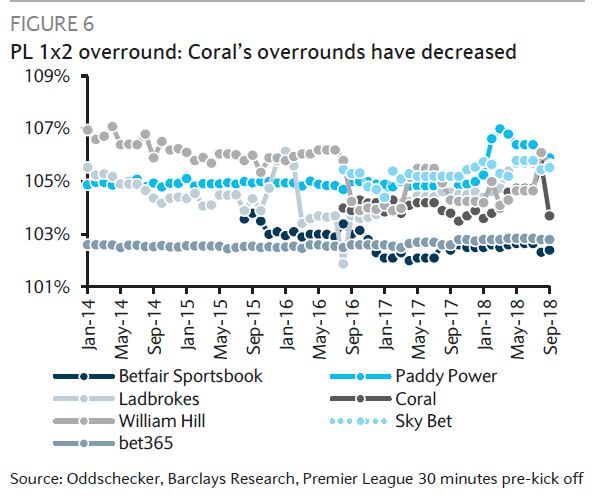
The operator has one of the lowest Premier League 1X2 overrounds at less than 103%, although its margin has not changed in recent months suggesting the growth is not necessarily price-driven.
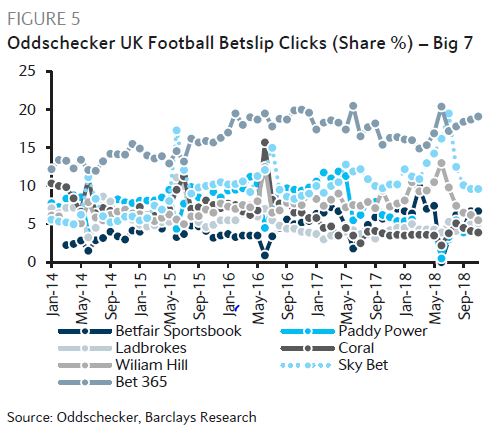
The operator finished ahead of BetVictor with 11.03% and Sky Bet with 9.52%
Barclays analyst Patrick Coffey also highlighted an increasing divergence between Ladbrokes and Coral overrounds, with Coral’s overround decreasing sharply in recent months.
Elsewhere, gross win margin across Oddschecker operators came in at 3.5% for November, the same mark as October, and slightly ahead of the long term average of 2.7%.
Oddschecker gross win margins are generally lower than industry averages as customers favour singles, are betting at best price and tend to be more price sensitive.
“The all-important Q4 period has so far been reasonable for bookmakers although you would not believe that if you looked at their share price performance,” said Barclays analyst Patrick Coffey.
“Investors are unlikely to breathe a sigh of relief until the very end of December. Remember the Q4 comp is extremely tough due to extremely high margins in Q4 2017.”
The margin was helped by a slight increase in draws in the Premier League form 23% to 26%.
Elsewhere Coffey flagged ongoing softness in new customer registrations through Oddschecker, especially at Big 7 bookies.
“We would flag that operators are increasingly discerning with regards to customer acquisition (value of volume), and there will have been an overhang after the World Cup,” Coffey said. “However, the UK is a maturing market with greater regulatory pressures so we will continue to track this data to see if if is representative of an underlying UK slowdown.”